Last week, I saw a ghost.
Not the rattling-chain variety, but the subtler kind. The kind that arrives at the winter solstice, when the year pauses and the light is at its weakest. I see them in the reflection of a dark windowpane. In a shadowed alleyway. In the whispered memory of things past. Each of them offers an invitation to peer into what Sheridan Le Fanu refers to as “a glass darkly” (a phrase borrowed from Corinthians).
It’s no accident that Christmas developed a tradition of reading ghost stories across many cultures. These late-night tales are meant to be told when the nights are long, and shadows hover just outside the firelight. Traditionally, the dark heart of winter has been a time for seeing what usually stays hidden. In the spirit of Dark Yule, I found myself thinking about A Christmas Carol this season, as I was visited by three ghosts of my own.
Take the ghost I saw last week. She was one of many I’ve seen this season. The first was in early December. I met the ghost of who I used to be: ambitious, overworked, and easily lost. I saw her for who she was, and who she needed to be to survive. Then I hugged her and set her free. I saw the ghost of Christmas present, too, in quieter endings—certain places and ways of thinking simply sealing themselves off, not with drama, but with a soft, unmistakable knowing. In her place is overwhelming gratitude for this beautiful life and the love I find I have in it—so much more than I thought I had in the dark days of the pandemic.
And I caught a glimpse of the ghost of what may yet be. Last week, she called to me unexpectedly at a local market. It was as if nobody saw her but me, and for a moment, time stood still. We spoke only briefly, and the content of that conversation is for me and her alone. But long after we parted, I knew I had experienced a memory from my future—what Patrick Harpur calls a daimonic moment—when time bends, and we connect with archetypal energies far beyond our everyday human experience.
On the shortest day of the year and the longest night, we peer into the darkness in search of light.
Peering into a Glass, Darkly
In Mexica tradition, priests used black obsidian mirrors to gaze at the sun. They would angle them toward the sun so that the light could pierce the dark stone. It appears like a pinprick of light, as if the sun has literally seared a hole into the dark mirror, even though it is only a reflection. The darkness, you see, was the only way the priests could safely gaze at the light. Darkness was not the enemy—it was the condition that made vision possible. I learned about this magical history from a lecture at a local brewery given by Kurly Tlapoyawa, an archaeologist, ethnohistorian, and host of the podcast Tales from Aztlantis.
The story behind the Mexica calendar and the winter solstice was powerful to me, as a Mestiza who is still learning about my roots. The use of obsidian as a mirror to see the sun feels deeply gothic and filled with gloomth. It echoes Sheridan Le Fanu’s In a Glass Darkly, where the daimonic never appears head-on, but only obliquely—through the uncanny, synchronicity, and the unexplainable. To see “in a glass darkly” is to accept that we can never gaze at the numinous directly. We see it out of the corner of our eye, in a strange sense of knowing, or by peering into the darkness—our psyches, our imaginal worlds, the stories that speak to us.
That is what storytelling does. It is the dark mirror that allows us to peer at things that would otherwise be invisible, whether in a holiday ghost story or in another kind of text altogether.
The daimonic always comes in sideways, as Harpur explains in many of his books. In order to experience the numinous, we must peer into the darkness: the monster under the bed, the skeletons in the closet, the ghosts on a moonlit road we’d rather avoid. The winter solstice—the longest night welcoming the return of the light—becomes an apt metaphor not just for shadow work, but for acknowledging that the world is much vaster than we can always perceive. Sooner or later, if a person wants to heal, they must dare to peer into a glass darkly and see what emerges.
Winter Solstice Liminality
This is Dark Yule Magic.
It is when you embrace the fallow period—the quietude and the slow return to longer days. It is a liminal time in which the shadows slowly recede, and with them, the heaviness of old selves and old stories, which we gladly commit to the Yule bonfire.
These are the moments when the dark mirror speaks, not of doom, but of hope. You never approach the numinous directly. You look through the obsidian mirror. And if you’re willing to stay with the darkness long enough—long enough to let the ghosts speak—you begin to see the light.
Wishing you a luminous Winter Solstice season, filled with the right kind of darkness—and light.
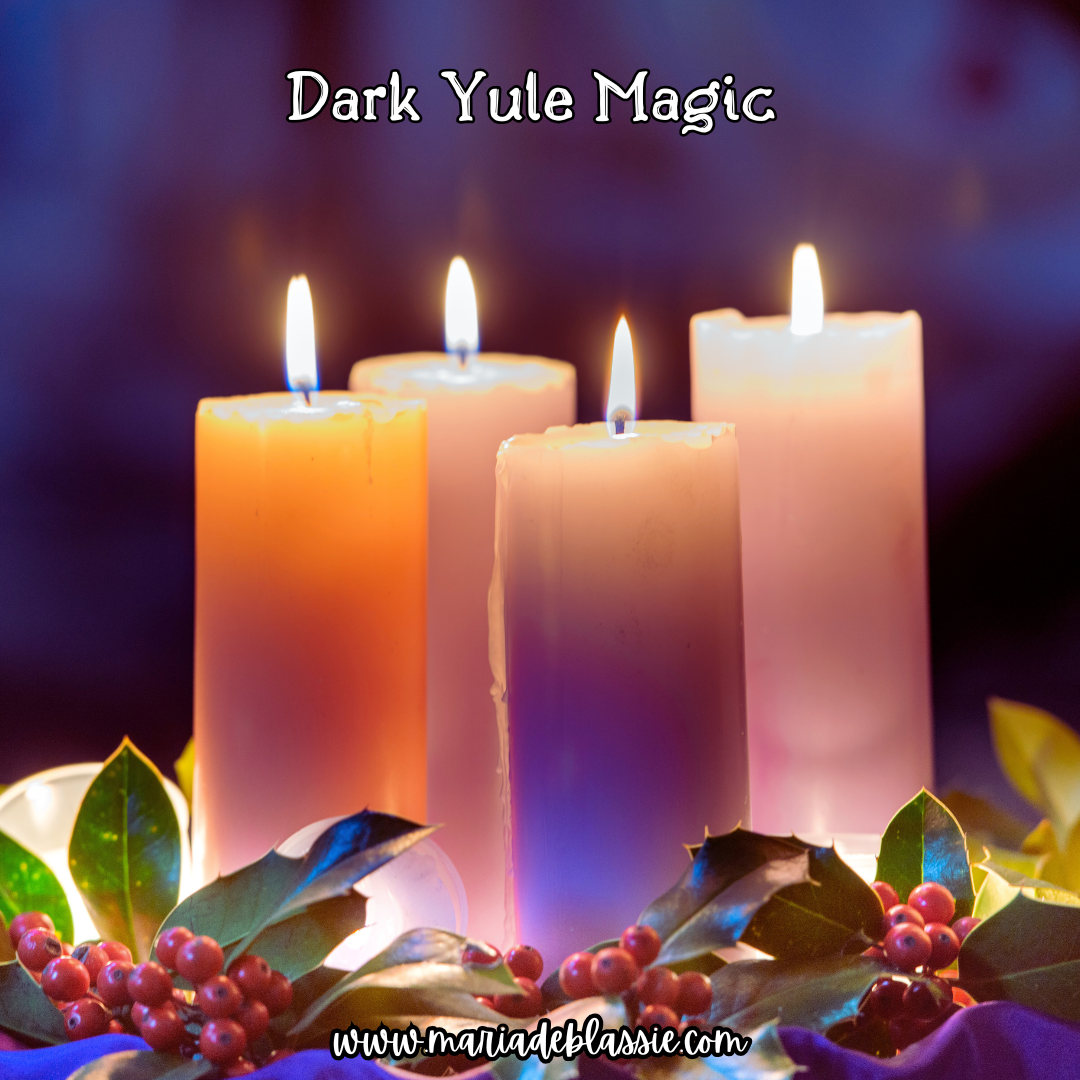
Atl text: Four lit pillar candles in orange and pink hues surrounded by holly leaves and red berries with the text "Dark Yule Magic" above.
Enchantment Learning & Living is an inspirational collection of musings touching on life’s simple pleasures, everyday fantasy, and absolutely delectable recipes that will guarantee to stir the kitchen witch in you. If you enjoyed what you just read and believe that true magic is the everyday, subscribe here.
Want even more inspiration to make your dream life a reality? Follow me on Facebook, Pinterest, and Instagram. Thanks for following!
