Enchantment Learning & Living Blog

Welcome to Enchantment Learning & Living, the inspirational space where I write about the simple pleasures, radical self-care, and everyday magic that make life delicious.

The Sacred Necessity of Hope

Every May, when Beltane rolls around, I want to stop and smell the lilacs, wear flowers and ribbons in my hair, and bask in the heady softness of spring. I feel brand new again—like a young girl eager to meet the world.

There is something about this season that softens me. The air is fragrant with the smell of growing things. The trees dance, their leaves impossible shades of green. My garden begins to hum with life again. Borage and salvia burst from their seeds, and tender sugar peas climb their trellises.

I sip hibiscus and rosehip iced tea as I write and buy flowers simply because they delight me. I don softer colors and softer clothes. I find myself in the kitchen cooking meals inspired by my garden hauls—radishes, turnips, carrots, and tender lettuces, to name a few. The world itself seems to sigh awake after sleeping all winter.

And every year, around this time, I find myself thinking deeply about hope.

Not the hollow, copy-and-paste optimism peddled by toxic positivity culture. Not the insistence that everything happens for a reason or that pain can simply be overcome through the proper mindset. That kind of forced positivity has always struck me as profoundly disembodied—an attempt to bypass the very real grief, exhaustion, and uncertainty that come with being alive.

No…the kind of hope I mean is something older. Stronger. More sacred. I’m talking about the bone-deep belief that life continues to grow in beautiful and unexpected ways.

It’s important to know that after periods of loss, stagnation, or unrequited longing, something tender can still bloom. That joy and grief can coexist. That delight remains possible even after heartbreak. That our stories are not over simply because we have suffered or because certain chapters remain unwritten.

Perhaps this is one of the reasons I love romance novels so deeply.

I just wrapped another semester teaching my historical romance course, and once again I found myself thinking about the importance of happily-ever-afters (HEAs). Romance novels are often dismissed as frivolous and escapist. They face the most terrible critique, at least in academia, of being UNSERIOUS. But I think it’s a mistake to dismiss a genre rooted in joy. In fact, I think romance understands something profoundly important about human survival: we need pleasure, and we need hope.

The happily-ever-after is not a denial of suffering or real-life stuff. Romance novels are filled with grief, longing, vulnerability, alienation, and fear. The characters suffer. They lose things. They misunderstand each other. They struggle against social systems that attempt to constrain who they can become and who they are allowed to love.

And yet, the genre insists on hope anyway.

It insists that connection remains possible. That tenderness survives. That people can evolve. That intimacy and joy are worthy goals.

In a world that often feels shaped by cynicism and exhaustion, I think that insistence matters.

Lately, I’ve noticed a cultural hunger for stories filled with delight and beauty. People are ecstatic over the announcement of The Devil Wears Prada 2. (It me. I am people.) We swoon over films like You, Me, and Tuscany with its gorgeous landscapes, emotional sincerity, and unapologetic softness. The protagonist in You, Me, and Tuscany, in particular, feels significant because she shows that women of color are allowed to be messy and complicated and yet still capable of loving and being loved. The Devil Wears Prada 2 gives us an Andy who has aged, lived, and gone through things—and yet still manages to be glamorous and capable even as she doesn’t have it all figured out yet (except for a better wardrobe). We crave stories that allow us to imagine lives shaped not only by struggle but by pleasure, beauty, belonging, and joy, now more than ever.

I don’t think this is accidental.

I think people are tired of irony. Tired of doomscrolling. Tired of narratives that insist survival alone should be enough. Or maybe it’s just me. (It’s definitely not just me.)

I want stories that remind me that life can still surprise us. What’s more, I think there is something deeply spiritual about that desire.

And why shouldn’t there be?

Working on my latest book, The Bruja’s Guide to Tarot: A Contemplative Guide to Conversing with the Cards (more on that soon), has only deepened this feeling for me. Tarot, like romance, is ultimately rooted in possibility. The cards aren’t there to tell us what terrible thing awaits us or forecast a picture-perfect future. Instead, they ask us to explore what transformations are unfolding beneath the surface of our lives right now—what we aren’t seeing in the daily hustle and bustle, but what is no less important than making our way through our perpetual to-do lists.

Tarot invites us to explore our lives symbolically, to cultivate a deeper relationship between our inner and outer worlds…and to see what magic comes of it.

These different ways of cultivating hope—reading romance, reading the tarot, living with an open mind and an open heart—remind us that life moves in cycles. That endings become beginnings. That growth is often nonlinear and surprising. Even the most difficult tarot cards contain movement. Possibility. Change.

That, too, is a kind of hope.

And maybe that’s why Beltane feels so emotionally resonant to me every year and why I celebrate it all May long. It is a holiday of becoming. Of sensuality and aliveness. Of stepping fully back into the world after the long inwardness of winter. The flowers bloom shamelessly. The earth insists on beauty again. The world does not apologize for its abundance.

Neither should we.

For those of us living under systems that profit from our exhaustion, cultivating joy can feel quietly radical. Especially for marginalized people like myself, delight is often treated as frivolous or undeserved. We are taught to focus on survival, productivity, resilience, and endurance. Rarely are we encouraged to pursue pleasure, softness, beauty, or ease.

But survival alone is not enough for a meaningful life.

We deserve wonder.

We deserve rest.

We deserve tenderness.

We deserve futures worth imagining.

That is why I believe HEAs matter. Not because life is perfect, but because hope itself is necessary to living. We need stories that remind us that transformation is possible. We need reminders that our lives can continue unfolding in joyful and surprising directions.

And perhaps that is the true magic of Beltane.

Not simply ribbons and flower crowns—though I love those things dearly—but the sacred invitation to believe in life again. To trust in becoming. To remain open to delight.

So here, at the end of May, I invite you to lean toward softness. Buy the flowers. Read the romance novel. Dance under the moonlight. Wear colors that make you feel alive. Let yourself imagine a future shaped not only by survival, but by joy.

After all, hope is sacred work, too.
Enchantment Learning & Living is an inspirational collection of musings touching on life’s simple pleasures, everyday fantasy, and absolutely delectable recipes that will guarantee to stir the kitchen witch in you.  If you enjoyed what you just read and believe that true magic is the everyday, subscribe here.

Want even more inspiration to make your dream life a reality?  Follow me on Facebook, Pinterest, and  Instagram.  Thanks for following!
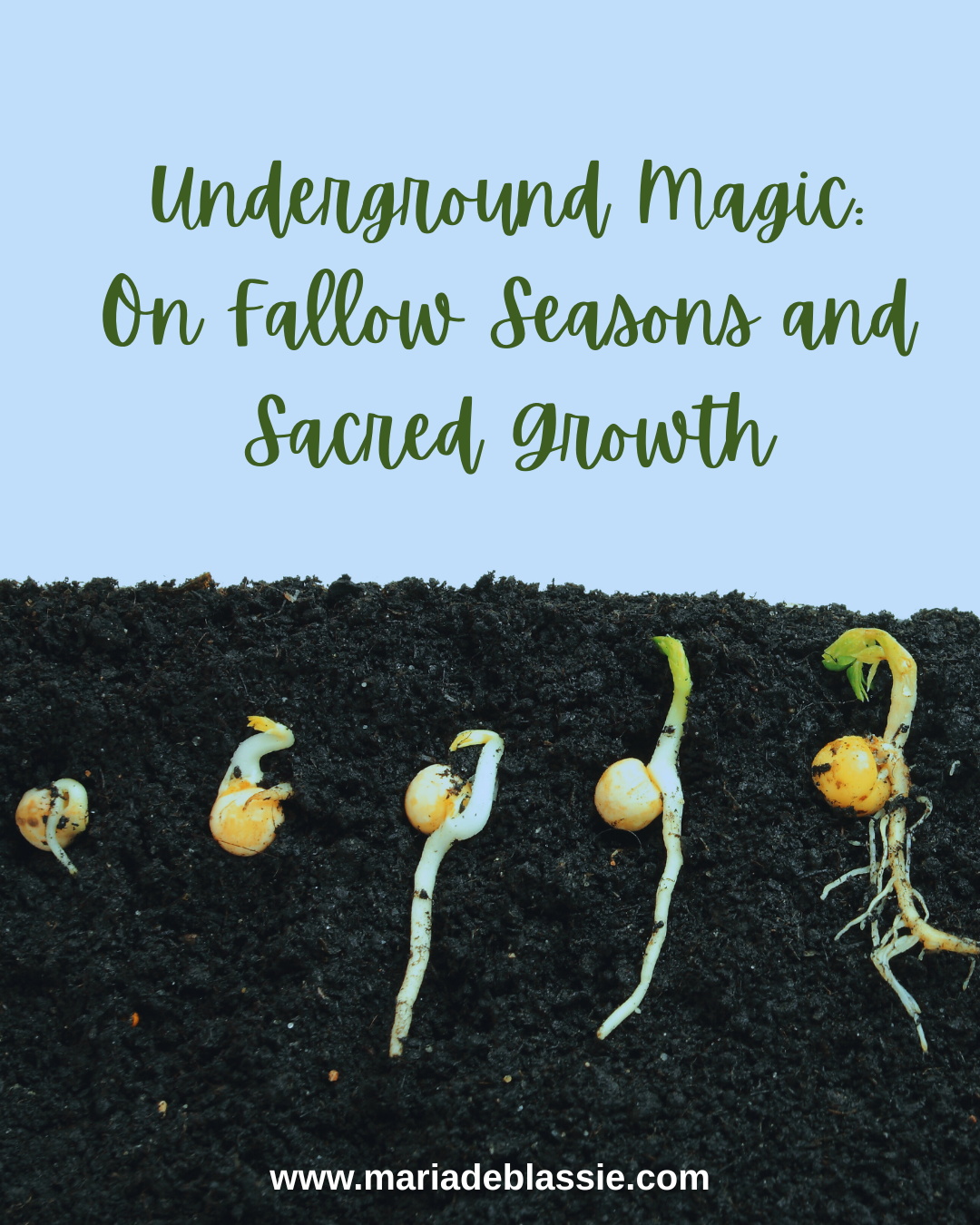
Underground Magic: On Fallow Seasons and Sacred Growth

I’ve got that itch.

You know the one.

The one where you are hungry for green and growing things. Eager for hands in fertile soil and ground bursting with potential. Excited for daffodils and tulips and all those wishes you planted last fall finally finding the sun.

So you collect seeds and stare longingly at garden catalogs and dream about your garden. You add your compost and hay and not-so-patiently wait for time and the elements to do their work. This, perhaps surprisingly, is one of the harder parts of gardening and of soul tending.

We want the blooms.

The splashy spring flowers and the delicious snap peas, the red radishes and the orange carrots. We look for signs of growth in green shoots poking through the earth and snowdrops and grape hyacinths dotting our landscape. And why shouldn’t we? These things nourish the soil and the soul.

But here’s the thing: it’s also important to appreciate the fallow periods.

There are no flowers and delicious spring herbs without rest. We put our gardens to bed in the fall. We cover them in compost and soil amendments, mulch and TLC. It’s an essential part of any healthy growing period. The soil needs time to rest and revitalize. It’s unsustainable for it to always be producing. Even the bees and other beneficial insects overwinter in hollowed-out flower stems and dried-up seed pods.

It’s not glamorous, but it’s perhaps one of the deepest forms of magic: letting things be.

Allowing things to rest. Permitting time to do the work. Not pushing forward but rooting into the moment. I tell this to myself, repeatedly, as I grumble and ache for signs of growth.

In my garden. In my life. In the deepest of dreams, buried in soil like garlic and onion bulbs. But then I take a breath, especially on days like today, ones that tease spring, though surely we will get one more snow before the seasons fully shift. I remember that life—soul seeds and turnip seeds—cannot come into this world without a gestation period.

We prize green shoots that usher in a new season. But long before they appear in our garden beds, the seeds have been quietly resting, stratifying, and cracking open to deepen their roots. A whole winter goes by as they find a way to shake loose their husks and transform into something more. They learn what they can become in the darkness. Without witness and without visible progress.

A lot goes on beneath the surface, in other words, when we’re looking at growth.

Sometimes it’s a feeling. Sometimes, a shift in perspective. Other times, it’s a conversation that washes over your body, making you feel whole. Sometimes, it’s not overworking the soil in your desire to get things moving. These aren’t things we can easily explain or check off a list. The deeper work is often so subtle that we might miss that we’re doing it as we go about our day.

But isn’t that the magic?

Showing up, being present, and attending our daily tasks even if we don’t get the immediate gratification of visible results. Our time and care do the work.

Rest is important in a culture that values productivity. We are conditioned to push forward and manufacture success. But that kind of artificial progress isn’t sustainable and rarely leads to meaningful growth. Real change is almost imperceptible as it is happening. It takes over slowly, in the small acts and intentions we bring to our days, and we only know the change has rooted within us when we look back at what felt like a dormant period and see irises and crocus flowers in our wake.

So, as I gaze toward spring, I pause. I relish the remains of this fallow period, grateful for the darkness and the quiet that help us make our way toward the light in the spring.

What soul seeds have you been tending this winter?

Alt text: Seeds germinating in soil beneath the text "Underground Magic: On Fallow Seasons and Sacred Growth."

Enchantment Learning & Living is an inspirational collection of musings touching on life’s simple pleasures, everyday fantasy, and absolutely delectable recipes that will guarantee to stir the kitchen witch in you.  If you enjoyed what you just read and believe that true magic is the everyday, subscribe here.

Want even more inspiration to make your dream life a reality?  Follow me on Facebook, Pinterest, and  Instagram.  Thanks for following!

Hope Takes Work

I’ve just come in from my garden. It’s not quite in spring bloom yet, though the daffodils are tilting their yellow heads to the sky and the chives are already clustered together, chattering wildly. Most of the earth is covered in hay and dried leaves. Aside from a few early onions dotting the landscape and nettleleaf already launching her eager spirit out of winter hibernation, it looks very much asleep.

But there is life stirring…

The seeds and the roots of returning plants are slowly waking up. The soil is getting warmer, and the birds are singing the return of spring. Soon, those seeds will crack open and spill out their green hearts and give me (and the bunnies) lettuce, radishes, turnips, beets, carrots, and more herbs than I can count. For now, I find joy in laying down compost and chatting with the grape hyacinths and the gossipy little finches. They always have so much to say!

These garden conversations fill me up after weeks (months? years?) of grappling with a very difficult political climate. You might have noticed that I haven’t been present on social media as much. That’s because everything has been going to reinforce our support networks for our students and community members with historically marginalized identities where I teach. Everything has been about staying grounded and, yes, hopeful, as we hold true to our values of connectedness, inclusion, and humane education. Everything has been about creating safe spaces and celebrating the fact that, despite what the news might continually tell us, there are many, many people in the world who value and protect our diverse communities, including those we share with the natural world.

I take comfort in that fact as much as I take comfort in the daily routines that keep me grounded. Right now, I put on an old jazz record and sip rose lemonade as I finish writing this. Chicken, green beans, and potatoes roast in the oven—a simple, hearty dinner that is one of my sacred simple pleasures. It was a dinner staple growing up, and now I can’t imagine a Monday without it. It’s also one of my go-to meals when I need homey medicine. It is a perfect picture of a cozy evening at home, with my familiars napping on the windowsills in my new library…

Did I tell you I moved?

Yes, in the midst of all this upheaval, I packed my life up in boxes and hauled it to a glorious remodeled place that was complete with a room I’ve solely dedicated to writing and books. Readers, I have DREAMED of this—a sacred space given to writing and reading and stories. It is, in other words, a soul-nourishing haven where I retreat to when the world feels too full of hate and anger. I call this room The Library, for what place can be more sacred than one dedicated to the transformative power of a good book?

This is where I retreat to when the toxic noise of our political climate wears me down and I have no more room in my head or heart for another terrible something or other. Here, I heal. Here I find solace in stories and much wisdom. Here, I chase away the darkness and nourish hope. It allows me to settle and dream deeply—essential for any kind of transformative work—so I can get up in the morning and return to the world to work magic.

That’s how we help things. That’s how we conjure a better way of being. We show up every day and keep doing what we do. Because there is one fundamental reality:

Life keeps going…

We don’t stop living, even though we have entered a strange period in time. We don’t stop loving or laughing or dancing. In fact, I think those things are more essential than ever. So I buy myself roses to celebrate spring and plants for those I love because nothing makes a person feel more hopeful than growing things. I dance to the cumbia music in my living room because why not?

I take small moments to walk around my campuses and take in the glorious mountains and the glorious birdsong. I make time to chat with people at my colleges and learn their names and their stories and relish the fact that, together, we make our campuses beautiful, loving places to be. And I read trashy novels, because seriously, there is nothing more refreshing than a little escapism, nothing that can make us find ourselves as much as a juicy story filled with plot twists and daring acts of living.

More importantly, reading these books helps me stamp out the darkness that comes, hungry, always hungry, to feed on our doubts and worries and fears. I fill up on good relationships and good stories so that I don’t turn to the darkness for comfort. 

Don’t feed the darkness…

I love pop culture and a good story that speaks to us, even—especially?—if it isn’t the kind of literary fiction that is so often fetished by academics. That’s why I’m drawn to Once Upon a Time, the hit TV series that is one part telanovela, one part modern fairy tale, one part exploration of archetypal fairy tale characters. One central theme of the series is that hope is a powerful thing.

There is a scene in the middle of season three where Rumpelstiltskin is half-mad, spinning straw into gold and singing. I won’t get into all the details that lead up to this because they’re A LOT. But what is important here is what he sings: 

“You feed the madness and it feeds on you.” 

That line keeps returning to me lately, only as “you feed the darkness and it feeds on you.” Darkness is madness. And there are enegries in the world that want to suck us into the collective frenzy so that they can feast on the discord. As the titular Dark One in the series, Rumplestiltskin knows all about the lure of darkness. It is seductive and addicitve in its way, and, if you’re not careful, it will suck you in. It feeds on you as much as you might feed on it. 

There’s a lot of darkness in the world right now, so it’s important that we pull away from it and nourish what is vital and good.

But hope takes work….

You have to get up every day and look for the light. I look for it now in my new home, which offers me a gorgeous view of the Sandia mountains. I see the sun break over the horizon and am grateful for the opportunity to experience it. I let the morning light wash over me and fortify my spirit. 

We can’t afford not to hope—and actively engage with the world in a way that makes it a better place. And that is certainly a lot harder than giving up. It’s also a lot more exciting. Joyful. Heartening. Invigorating. And, dare I say…fun. These are all vital emotions we need to cultivate in order to thrive.

I’m drawn again to fairytale wisdom after seeing the live-action adaptation of Snow White. Despite its dismal reviews, I really enjoyed the movie and how it updated the classic animated film. For starters, Snow White has agency. Her kindness isn’t one-dimensional. She’s emotionally literate and cares about those around her. She’s empathetic and a good listener. She’s brave and thinks creatively to find solutions to difficult situations. Snow White defeats the Evil Queen not by using the same violent tactics as her stepmother, but by offering another way of being in the world. She reminds those around her that they, too, can be brave. They, too, can do things differently. And that is her power. 

Snow White is reminiscent of the Strength card in the tarot. In it, a woman calms a wild lion. She does not try to trap or hurt it. She offers comfort and a quiet resilience. Softness, this card reminds us, is a type of strength.

So as we move forward in these uncertain times, as we keep living and loving and changing, we must look for moments of joy, cultivate softness and openness, and always, always nourish hope and all that is vital and life-affirming.

At the end of the day, we take comfort and medicine where we can. Nurture meaningful connections. And plant seeds for a better future.

What seeds will you plant this spring?

Tarot card of Strength on a yellow background with white daisies.

Enchantment Learning & Living is an inspirational collection of musings touching on life’s simple pleasures, everyday fantasy, and absolutely delectable recipes that will guarantee to stir the kitchen witch in you.  If you enjoyed what you just read and believe that true magic is the everyday, subscribe here.

Want even more inspiration to make your dream life a reality?  Follow me on Facebook, Pinterest, and  Instagram.  Thanks for following!

Beltane Spells

On May first, I wove ribbons in my hair and danced in the meadow until the buzzing in my heart matched the buzzing of the bees.  On the sixth, I ate tender strawberries and enjoyed the feel of each tiny seed slipping down my throat. On the twelfth, I planted lemon balm because I am forever in need of soothing and sunshine.  I somehow never quite trust soft gentle things when they pad into my life like a cat ready to luxuriate in my attention—but I’m learning.

Even the tarot gives me sunshine. Again and again, it asks me to let the light in.  I wish it would tell me how because the only way I know is to surround myself with sunflowers and jazz records and radishes so red they look like they could stain my fingers with their exuberance.

Then today I tried to capture the scent of lilacs as they fade and give way to summer—knowing full well I will have to wait until another turn of the wheel to savor their ephemeral perfume fresh from the bud.  But that doesn’t stop me from bottling what I can of their essence so that when I am bottled up I can uncap that violet vial, breath in, and remember that I am a spring evening—full of softness and invitation to those willing to linger in solitude under the moonlight.

I am as wild as a dandelion head, made up of wishes that will fearlessly find their place in the world, not the stiff thoughts that fill my mind when I try to mend the things that keep falling apart—Orpheus was right. Nothing good ever comes from looking back.

Instead, I wash myself in lilac perfume to remember that the world is full of soft and sweet things and that I needn’t always smell of sweat and tears.  I let my bare feet kiss wet grass. And I take the last lilac buds to weave with the ribbons in my hair so that even my dance is a magenta promise of something more.

Enchantment Learning & Living is an inspirational blog celebrating life’s simple pleasures, everyday mysticism, and delectable recipes that are guaranteed to stir the kitchen witch in you. If you enjoyed what you just read and believe that true magic is in the everyday, subscribe to my newsletter below for regular doses of enchantment. Want even more inspiration? Follow me on Instagram, Facebook, Pinterest, and Twitter. Here’s to a magical life!

How to Cultivate a Witchy Garden

It’s that time of year when I’m dying to get my hands dirty.  I’ve been collecting seeds all winter and have started prepping my garden space by turning the soil, cleaning up the debris that protected it over the colder months, and thinking about where I’ll put my plants. I’m dizzy with the promise of a summer in my magical garden space where my biggest concern is harvesting and drying my medicinal herbs fast enough—the hard years of pandemic teaching forgotten under the sun’s nurturing gaze and the pliant soil beneath my feet.

This is a feeling that is always with me, even in the winter, warming my soul when it’s too cold to be outside.  You see, I grew up in a magical garden.  My mother was the original kitchen witch who grew so many herbs and plants in our backyard that stepping out there was like entering this secret garden of enchanted things—it still is!  

I remember when I learned that the licorice and lavender and lemon verbena she planted had medicinal properties and that you could steep them to make delicious and healing tisanes. I was obsessed with collecting these plants, brewing with them, and drying them to store in cool jars I’d collected over the years.  Yeah…I think it’s pretty clear that I was always kind of witchy!

Even when I left home, I made it a point to bring a little bit of that garden magic with me wherever I went. Sometimes it was just a few plants on a windowsill in my grad school apartment.  Other times, it was a magnificent patio garden, complete with vermicompost, where I grew all sorts of culinary and medicinal herbs.  Or it was an open space where I could sneak away to plant early spring leeks and onions or the Pinterest board where I pinned everything I wanted in my dream garden, the place I’d cultivate when I lived in my forever home (yes, it will closely resemble the house in the movie, Practical Magic, naturally). 

Plant magic is so much a part of my being, especially as a bruja, that I’ve come to think of my garden as an enchanting space for conjuring.  I have a natural affinity for plants and have often sought solace in their company when the outer world gets to be too much (truly, plants and cats are much more sensible than humans, at least that’s what my familiar says, and I tend to agree with him). 

Sometimes, though, it might seem like a daunting task to create a witchy garden full of medicinal herbs and magical plants.  Where do you start?  How do you maintain it?  What plants do you use?  The most important thing to creating a magical garden is your intention—that desire for a more magical life—and taking enjoyment in learning as you go.  

So, if, like me, you’re looking to be witchier than ever this year, here are a few tips, in no particular order, to cultivating a witchy garden.  It goes without saying, however, that any witchy tips you get here are general guidelines—see what resonates with you and then make your own magic as you develop your relationship to the space you’re working with and the plants that speak to you. 

Don’t get too manictured! I quietly cringe at the perfectly manicured gardens in magazines.  I can practically hear the plants screaming to be free! A garden should be a sanctuary where you let your hair down, walk barefoot, and forget about the world for a bit.  Where you plants can thrive and grow wontonly.  Sure, tend your garden, but don’t turn it into the environmental equivalent of those airbrushed models on a magazine cover—they’re not real and should not be images of beauty we aspire to. Instead, embrace the wild messiness of growing things.  It’s good for the soul.

Remember that all plants are magic. Who didn’t spend afternoons as a child gathering roots and twigs and leaves and stirring them up to make potions and mudpies? It’s as if we all instinctively knew there was something magical to these living breathing things. (If you are one of those rare and strange creatures who never did that…I feel sorry for you.  But that doesn’t mean you can’t enjoy that kind of fun now—go get your hands dirty and collect plants that call to you!).  As you go about cultivating your garden, learn about the flowers, herbs, and produce your plant. They all have lovely magical, medicinal, and, yes, even mundane histories.  Each of them has stories and there’s something powerful to learn more about them. You’ll be surprised how much of their stories

Talk to your plants…and don’t be surprised if they talk back. Oftentimes, the plants we are most attracted to have the medicine we need.   For example, one year, I was deeply drawn to Juniper, the seeds, the leaves, and the sharp smell of its essential oils.  I later learned that Juniper is a deeply healing plant that is specifically known for taking negative energy and turning it into light.  As it happens, that was the exact magic I needed as I was healing from some toxic situations and learning to find my own happiness again.  And, yeah, you should check on your plants and talk with them as you tend them.  My mornings aren’t complete without a cup of coffee in the garden and a good chat with growing things before I draw the tarot.

Leave those weeds for the birds and the bees. Okay, I know that we don’t want a garden that’s overgrown with weeds but some are seriously important! This goes back to not being too manicured.  The garden is a living ecosystem so leave those dandelions to help our pollinators, just as wildflowers attract birds who help keep pests in line. Some plants that are so aggressive they become like weeds (I’m talking to you, mint!), so do what you have to do to make sure you keep your unwanted plants in check but allow your garden to be a joyful wild ecosystem that isn’t hemmed in by hospital-like tidiness. The wildlife and your mind will thank you!

Embrace composting. There is nothing more magical than taking scraps and other discards and turning them into pure gold.  It’s positively alchemical! Composting is a fairly easy thing to learn how to do and one of the cheapest and most eco-friendly ways to nourish your plants--seriously, ditch the chemical fertilizers and other junk that’s bad for the environment.  I also like to think of all the energetic junk I’m composting for future fertile soil as I feed my vermicompost or turn the heap.  It makes me feel like no experience, piece of writing, or feeling is wasted.  Even if it’s something I have to let go of, it has done its part to help nourish my inner garden.  It’s very cathartic!  

Know your local ecosystem.  I love my local medicinal plants like globemallow and yerba mansa, not to mention the drought-hardy Hollyhocks.  Part of cultivating a witchy garden is knowing the land around you and the plants and animals that thrive there.  When you garden in harmony with the environment around you, you produce better yields, have happier plants and wildlife, and embrace your inner wildflower. 

I suppose if there’s one last bit of advice to give you as you cultivate your witchy garden, it’s to listen to your intuition. Plant the plants that make you happy. Design your space in a way that soothes the soul. Go slow. Enjoy the sacred simple pleasure of time spent with growing things. And always, always make a little time each day to get your hands dirty.

Enchantment Learning & Living is an inspirational blog celebrating life’s simple pleasures, everyday mysticism, and delectable recipes that are guaranteed to stir the kitchen witch in you. If you enjoyed what you just read and believe that true magic is in the everyday, subscribe to my newsletter below for regular doses of enchantment. Want even more inspiration? Follow me on Instagram, Facebook, Pinterest, and Twitter. Here’s to a magical life!