I had the profound honor of serving as the keynote speaker at the UNM McNair & ROP Emerging Scholars Ceremony this spring. I was utterly inspired by seeing so many graduating scholars preparing to move on to graduate school and so many incoming scholars conducting important research in their fields.
Together, we make higher education a safer, more inclusive space for those of us with historically marginalized identities.
This work is as important to me as the work I do as a writer, which involves rethinking the types of stories we tell about ourselves and our communities. Together, we can conjure a more hopeful future through the work we do and the new narratives we create.
I cannot stress enough how grateful I am to my parents for paving the way for me and showing me how transformative education can be, and how happy I am to pay that forward with the next generation. Together, we can change the face of higher education. Happy reading!
Below is the transcript of my talk, although I admit there was so much more I wanted to say, and there was some free-styling in the actual speech. You can also watch the video recording of it here (although the first part of the speech was not recorded).
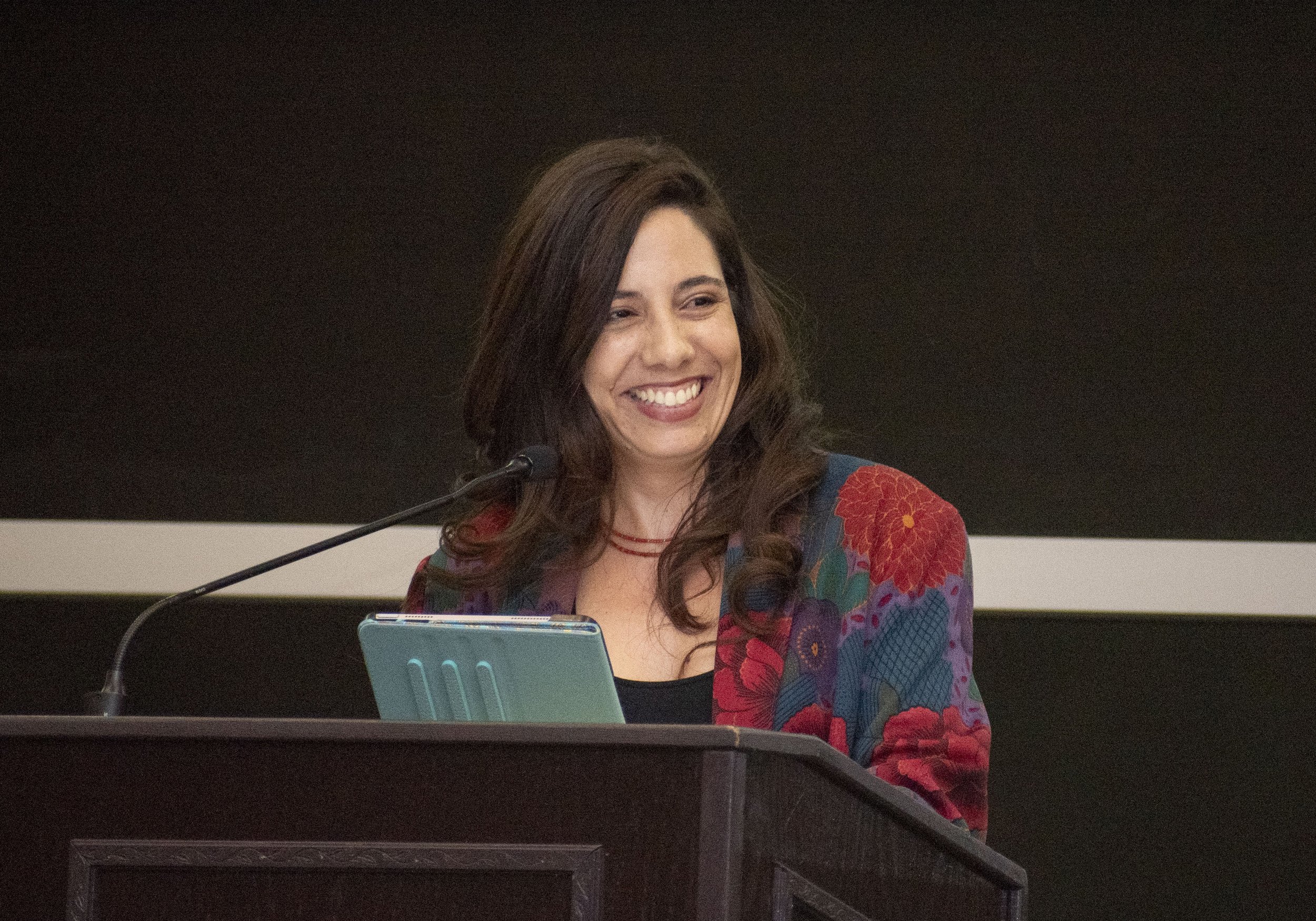
Good evening, everyone—thank you to our guests, faculty, families, and friends for being here tonight, and most importantly, congratulations to our incredible McNair and ROP Scholars.
It is truly an honor to stand before you today as a PhD alum and a former participant in two programs that changed the trajectory of my life. When I look out at this room, I don’t just see students—I see future researchers, professors, innovators, and leaders. I see colleagues and friends. I see community.
I see new ways of understanding the world, and pathways that each of you will create—paths so innovative and meaningful that we can’t even fully imagine them yet. And honestly? That’s the most exciting part.
Today I want to share a little bit with you about my journey and invite you to think about where you are now and all the incredible things you will accomplish in the future.
Before McNair: Where It All Began
As a mestiza—a woman of Indigenous, Latine, and European descent—it was rare for me to see someone who looked like me among the faculty here at UNM, even though this institution serves so many Hispanic, Latine, and Indigenous students. Fairly early in my college career, I knew I wanted to be a writer and an educator at the college level because of this.
New Mexico is a unique and wonderful state—one that both sides of my family have a long history with. Seriously, we’ve been here since New Mexico was part of Mexico and even before that. I wanted to bring that history, cultural background, and knowledge to higher education to better represent the demographic of students that we teach. Earning my doctorate would help me do just that.
I participated in the Research Opportunity Program from 2005–2006 and became a Ronald E. McNair Scholar shortly after. Through these programs, I earned a fully funded spot in the University of Washington’s English MA/PhD program.
At the time, I was studying 18th-century English literature—but not in a traditional way.
I was asking questions like:
Who decides what counts as “good literature”? Why is Western literature held up as the end-all, be-all?
Where do stories from marginalized communities fit into that conversation?
And what happens when we put so-called “trashy novels” in dialogue with the literary canon?
I was fascinated by storytelling—how it shapes identity, how it reflects lived experience, and how it can help us make sense of our lives.
But I was also navigating something deeper.
I didn’t always see myself reflected in the texts I studied—or in the faculty teaching them. As someone from a mixed-race background, I often felt like I existed in a liminal space—between cultures, between narratives, between expectations.
So I started asking:
What if we expanded the boundaries of what counts as “quality literature”?
What if we brought pulp fiction into conversation with the literary canon?
What if storytelling itself became a tool for healing, transformation, and belonging?
At the time, I’ll be honest—it sounded a little unconventional. Not everyone understood what I was trying to do.
And truthfully? I didn’t fully understand it either.
But it felt important. It felt like a thread I needed to keep following.
And it was one professor—just one, Dr. Carolyn Woodward in the English department, a very sweet little old white lady—who saw that spark and told me about ROP and McNair. I almost didn’t apply. But she talked me into it.
And that decision changed everything.
Full Circle: Why This Work Matters
Today, I teach writing at CNM and interdisciplinary humanities courses at the UNM Honors College. Can you guess what my course topics are? Trashy novels for starters and the intersection between classic literature and popular culture. It isn’t uncommon for my classes to explore what Jane Austen novels and Bridgerton have in common with Jane the Virgin and Laura Esquivel’s Like Water for Chocolate, or what Sinners, Bram Stoker’s Dracula, and Buffy the Vampire Slayer can tell us about otherness, belonging, and metaphysics.
I even show my students what The Wizard of Oz and Practical Magic have to do with curanderismo practices here in New Mexico. And yes, I weave in contemplative practices, emotional literacy, and personal reflection in these classes because we look to these stories to help us find our way through life.
My goal has always been simple:
To become the kind of educator I didn’t always see growing up. To create spaces where students, especially those with historically marginalized identities, feel seen, valued, and inspired. To encourage emotional literacy as well as scholarly excellence. And that is directly connected to my journey as an ROP and McNair scholar.
My McNair/ROP Journey: Transformation Through Opportunity
Before these programs, I had ambition—but not a clear roadmap.
I grew up in a household filled with books, with people who value reading and learning, but I still felt like an outsider in higher education. I didn’t know how graduate-level research worked. I didn’t know how to prepare for graduate school. I didn’t know a lot of things.
But I knew I wanted more—for myself, for my family, and for my community. And when I found McNair, everything shifted. For the first time, I wasn’t just consuming knowledge—I was creating it.
McNair gave me:
• Access to opportunities I didn’t know existed
• Mentorship from people who believed in me
• Community with peers on similar journeys
• Confidence in my ability to succeed
It helped me complete meaningful research. It prepared me to apply to graduate school with intention. And it taught me something even more important:
That my perspective—my background, my questions—were not barriers. They were strengths.
I stopped asking, “Do I belong here?”
And started saying, “I am a scholar.”
After McNair: The Long Game
After graduating from UNM, I entered a fully funded PhD program.
And I won’t sugarcoat it—graduate school is hard.
There were moments of doubt, exhaustion, and barriers to break through. For one thing, when I moved to Seattle, I had never seen so many white people in one place before, and it was almost impossible to find a good breakfast burrito. To say that I experienced culture shock is an understatement.
But more seriously, I had to navigate spaces where I didn’t always feel like I fit.
And yet—I was never alone.
I found community again and again through TRIO programs, through mentorship, and through peers who supported me along the way. I connected with the McNair Program at UW and the Graduate Opportunity Minority Achievement Program. As soon as I could, I started teaching composition classes that served underrepresented students who needed additional support. From there, I became a Student Support Services tutor and even taught for Upward Bound at one point. In other words, I found a home away from home in TRIO, and some of my best memories of that time are thanks to these communities.
I also realized that McNair had prepared me well for graduate school. It taught me resilience. It taught me how to ask for help. It taught me how to persist—not just to finish, but to grow.
Because of that foundation, I continued from year one to year two of graduate school, and eventually, I earned my MA and PhD within five years. I even had the honor of celebrating my doctorate with the UNM ROP/McNair scholars that summer, as I returned home early to begin my teaching career here in Albuquerque.
That journey took time. It took effort. It took support. But it was possible—because I didn’t do it alone.
Lessons for Today’s Scholars
So what can you do to make the most of your experience?
1. Take your research seriously—and stay curious. Perfection isn’t the goal. Growth is. Curiosity will take you further than fear ever will.
2. Build strong relationships with your mentors. They are not just advisors—they are advocates.
3. Prepare early for graduate school. Explore programs, ask questions, and choose environments that support you—academically, financially, and emotionally.
4. Practice resilience and self-care. Success isn’t about avoiding struggle—it’s about learning how to move through it. Rest is part of the work.
5. Lean into your community. You are surrounded by people who understand your journey. Support each other. Celebrate each other. Every time I felt isolated, the solution was the same: I found my way back to this community.
A Message to Families
To the families and friends here today: your presence matters more than you know.
I would not be here without my family and the paths they paved before me. My mom was a Pell Grant recipient who paused her education to support our family while my dad earned his doctorate. She later returned to school, becoming the first woman in her family to graduate college, and then she later earned her master’s degree, one she and I completed at the same time, which was a truly special experience. My older sister was the first woman in our family to earn her master’s degree. My younger sister was the first person in our family to earn a Fulbright fellowship, and I am now the first woman in our family to earn a doctorate.
That legacy shapes everything I do. As an educator, my goal is to continue clearing that path for those who come after me.
I see that same legacy in my students, especially the parents who bring their children to class. They may think they’re there out of necessity, but they’re doing something powerful: they’re making college familiar. I remember going to UNM with my mom as a child—feeding the ducks at the duck pond, sitting in classrooms next to her—and because of that, college never felt intimidating to me. It felt exciting and welcoming. That’s what my students are giving their children: a sense that they belong here.
Each generation makes the road a little smoother for the next. My parents did that for me, and now I’m committed to doing the same—for my students and my community. Whether it’s creating more accessible learning spaces, developing free educational resources, or building community-centered classrooms, my work is rooted in that commitment.
And through it all, TRIO programs like McNair and ROP continue to be a home for me—a place of collaboration, support, and lifelong community.
So, friends and family, you are part of this journey. Your encouragement, your sacrifices, your belief—it all contributes to the success of these scholars. I would not be here today if it weren’t for the incredible support from my family, especially my parents, including my dad, who knew what it was like to be a person of color in a white space, earning a doctorate. He talked me through a lot. I would also not be here today if it weren’t for my fellow scholars, past and present, cheering me on as I cheer them on.
Thank you for standing beside them.
You Are the Future
Lastly, I want to leave scholars with this: A note on impostor syndrome, because we all have it. Even now, with all my teaching and writing awards and successes, it still creeps in. So know this:
You are not here by accident. You are not here because of luck. You are not here to fulfill a diversity quota.
You are here because you are capable and smart, because you are resilient, and because you have something valuable to contribute to this world. There will be moments when the path feels unclear. There will be moments when you doubt yourself. In those moments, remember this room. Remember this community. Remember that someone who once sat where you are is now standing here telling you:
You’ve got this.
The future you’re working toward is already beginning. You have the power to change your lives, your communities, and your future professions.
And, I’ll leave you with one more thought, one I always tell people when they ask why I wanted my PhD so badly, in addition to the reasons I shared earlier. The answer is simple: Dr. DeBlassie.
It sounds so good. It feels so right.
I love knowing that when people hear the name Dr. DeBlassie, and they expect some old white dude and see a brown woman instead, well, that changes so many assumptions about what an educated person looks like. What a professor looks like. What a change-maker looks like. And it is because of this doctorate—the joy of being Dr. DeBlassie—that I now have the authority to make the changes in higher education I dreamed of over twenty years ago.
So, take a moment, scholars, and imagine how great your names will sound with doctor in front of them. Go ahead—do it. Sounds good, right? Keep that name with you as you journey forward—it’s only a matter of time before it’s yours.
Thank you and congratulations, scholars.
The Bruja Professor, a witchy take on literature, the occult & pop culture, is the scholarly sister to Enchantment Learning & Living, an inspirational blog celebrating life’s simple pleasures, everyday mysticism, and delectable recipes that are guaranteed to stir the kitchen witch in you.
If you enjoyed what you just read and believe that stories are magic & true magic is in the everyday…or your next good read, subscribe to my newsletter below for regular doses of enchantment.
Want even more inspiration? Follow me on Instagram and Facebook. Here’s to a magical life!