The Bruja Professor

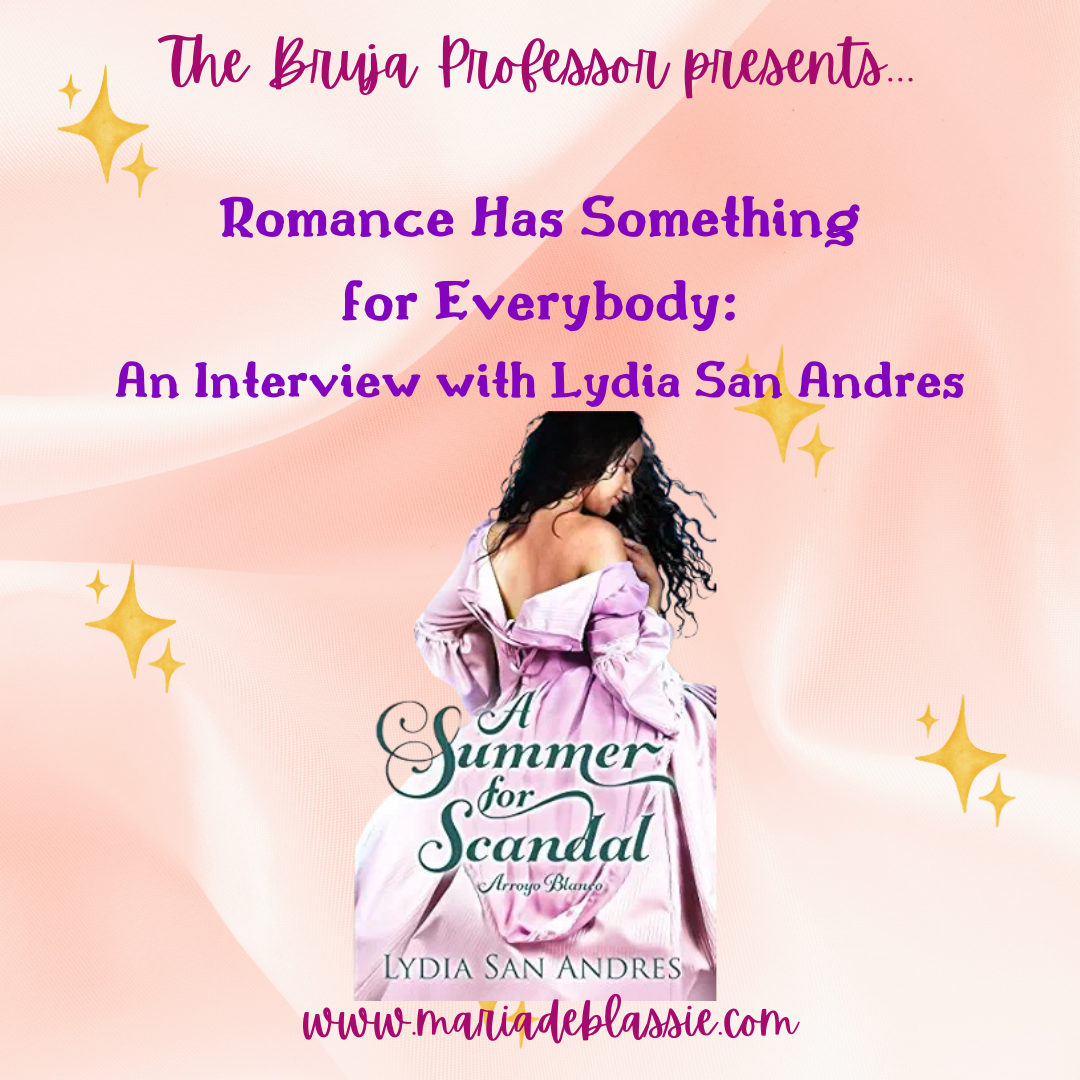
Romance Has Something for Everybody: An Interview with Lydia San Andres

A Summer for Scandal (2015) is one of the first historical romance novels I read that centered on people who looked like me. It was refreshing and delightful to see brown people centered in a story that had a happy ending. We often speak in my class about the importance of seeing yourself represented in stories with HEAs, so I knew I had to teach this novel when I designed the class. It also has some of my favorite romance novel tropes, including lady authors and secret identities. I was lucky enough to interview the author, Lydia San Andres, for my historical romance class. I hope you enjoy our lovely conversation and read her books. They are wonderful!

1. A Summer for Scandal is set in 1911 in the Spanish Caribbean in the fictional town of Arroyo Blanco. What made you decide to set your story in this time period? What drew you to this place for the novel? Did you do any research for this novel, and, if so, what surprised you most while researching?

After finishing a master’s degree in Art History, I began working as a research associate for an academic entity in the United States that studies Dominican history. Since I was the only member of the team who lived in the Dominican Republic, I was the one tasked with delving into the National Archives in search of whatever documents were needed for the projects their historians and sociologists were working on. I was so captivated by archival research that I started visiting the archives on my days off, purely to devour all the primary sources there. As I paged through digitized newspapers and magazines and scrutinized fragile handwritten documents, I began to get such a clear picture of what life in the late 19th and early 20th century was like here in the Dominican Republic that I knew I had to set a book there.

Around this time, I had just completed a Master’s in Art History and written a thesis on the history of poster design in the Dominican Republic. The months-long research for that had also involved delving into archives and sorting through—I’m not kidding—garbage bags full of posters and hand-painted signs. These had helped paint an even clearer picture. 

Back then, I was mainly writing fantasy. I saw historical settings as an opportunity to engage in something similar to worldbuilding, especially considering how patchy the historical record in the DR can be when it comes to the smaller details that make up everyday life. (Most of the documents that survive are governmental or the newspapers and magazines I mentioned above, and I haven’t been able to find any personal letters or diaries.) As I began to write A Summer For Scandal, I took the worldbuilding aspect even further and decided to invent my own Caribbean island as the setting, mostly because of the freedom it gave me to make things up.

I narrowed my range of research from 1900 to 1915, because in 1916, the Dominican Republic was occupied by the United States, and daily life changed drastically. I was surprised to find just how modern life was in that first decade and a half. There were advertisements for Colgate toothpaste in magazines, as well as many other brands we still use to this day.

2. What historical constraints (class, gender, religion, law, reputation, money) most shaped the protagonists’ choices—and which were you most excited to dramatize?

In this book, it was Emilia’s gender and her need to make money to support her family while upholding society’s ideals of how a woman should behave in order to keep her reputation—and therefore her marriage prospects—intact.  

Throughout history, women have always worked outside the home. In the early 20th century, especially with the growing appetite for industrial manufacture, women were joining the workforce at unprecedented rates. In the Caribbean, where industrialization wouldn’t come until later, there weren’t as many avenues of work for middle-class women outside of teaching and needlework. Emilia has a day job as a typist at an office, but she still needs to write on the side to make ends meet. (And probably because doing something that scandalous thrills her!)  

3. In my classes, I often talk about the importance of people with historically marginalized identities seeing themselves in narratives with a guaranteed HEA. What does it mean to write Latine romance to you?

When I began writing A Summer for Scandal sometime in 2014, I hadn’t been able to find any historical romances featuring Latine people and written by a Latine author. I hesitate to state that there weren’t any—if there were, they were very hard to find. 

Maybe it’s because I’ve lived in the Dominican Republic for most of my life, but I had this overwhelming desire to open the door to my home and bring other people inside and show them around. Growing up, it was very rare to see my country represented in American media at all—and the few times it was, it showed an incomplete and stereotypical version of reality. I remember one time reading a travel blog from an American who, after spending a week at an all-inclusive resort in Punta Cana, claimed that everyone in the D.R. lived in tents. I was flabbergasted, angry, and desperate to show the world that we are so much more than how we’re represented in the media.

 (I also seem to remember an episode of House Hunters International where a white realtor confidently said that no houses in the D.R. have ovens because it’s too hot. And I just???)

 Responding to that kind of thing was a big part of why I chose to set A Summer for Scandal in a fictionalized version of the Dominican Republic.

Luckily, that narrow way of representing other cultures has been challenged in the past decade, and I hope we continue to confront stereotypes and dispel silly or outdated notions. 

4. How did you think about consent and power differences (gender/class/reputation) in a historical framework while still meeting modern reader expectations?

This is often a difficult needle to thread when writing in historical settings. On the one hand, you want to fairly represent the attitudes of the time. (Which weren’t always as clear-cut as we in the twenty-first century tend to believe they were.) On the other hand, you don’t want to alienate modern readers. I always try to lean towards decisions that make my readers more comfortable with the characters, even when that means playing a little fast and loose with historical accuracy. I’m much more interested in conveying my characters’ intent and crafting people that my readers can relate to because that’s an important part of the reading experience for me.

5. You use two of my favorite tropes in A Summer of Scandal: the woman writer heroine and the exploration of public versus private personas. Can you unpack why you chose these tropes and what they allowed you to explore in this story?

A Summer for Scandal was supposed to be the first in a series. The books that would have followed it also delved into the differences between how we present ourselves in public versus in private. This is something I wrestle with frequently as someone who lives in a fairly conservative society and who is often frustrated by the Dominican need to present ourselves as perfectly respectable at all times. The struggle felt relevant in a historical setting where reputation was so important, especially for a woman. 

This theme is also present in The Infamous Miss Rodriguez, a novella in which the main character Graciela (briefly glimpsed in A Summer for Scandal), decides that the only way to get out of an unwanted engagement is to ruin her reputation. 

 For reasons I should probably examine in therapy and not here, I felt it resonated in my own life—I’m an elder daughter who has always been held up as an example of a Good Girl because of how I present outwardly. This is particularly funny to me because most people rarely suspect that, like Emilia and Graciela and most of my heroines, I’m actually a rebel at heart.

As for Emilia being a writer, it had a lot to do with the ways a woman could earn money in the time period and her bravery in choosing to write about female sexuality even under a pseudonym. 

6. Where do you see this book sitting in the broader tradition of historical romance—what authors/books were you in dialogue with?

I’m not sure if I was consciously engaging with any one author or book. At the time, it very much felt like I was doing my own thing, informed by the research that was consuming a lot of my time. And it definitely felt like I was writing outside of the genre in some way—I never bothered to query agents or editors because I thought that an audience used to Regency England wouldn’t find much of interest in my books.

Of course, in hindsight, I can see that this was a time when the genre was shifting to make room for new and different perspectives. Historical romance heroines were increasingly portrayed as crusaders for social justice and female suffrage, and they were confronting their sexuality in a different way than their predecessors. I wasn’t writing outside of the genre at all. I was in the thick of it.

7. What do you love about the (historical) romance genre, and why did you choose to write in it? How has your relationship to romance novels changed over time?

I would say that my love for the genre began with my love for history. Even when I was writing fantasy, my stories rarely took place in a contemporary setting. I don’t know if I made a conscious decision to write historical romance; I think I just wanted to write a romance, and the past is where I’ve always felt the most comfortable. I’ve always found it much more exciting than modern life—I don’t know if I can verbalize it, but the 19th and early 20th century just speak to me. They feel like home.

 I didn’t start writing contemporary romance until 2019, when I started the book that is going to be coming out in 2027. (As I write this, I just finished revising it.) The only reason it’s contemporary is that its themes and plot are very much tied to the experience of modern fandom, and I wasn’t able to translate it into a historical setting even though I tried pretty hard! 

As of right now, I’ve written two romantic comedies set in the present day. If my relationship to romance novels has changed in any way, I’d say it’s expanded to allow these newer stories in.

 8. Over the years, I’ve had more students taking my classes specifically because they love romance novels and want to engage with them more seriously. This means we often talk about our favorite themes and tropes and how they’ve shaped us. What’s your favorite trope or theme, and why?

I am always weak for an enemies-to-lovers trope! There’s something so deliciously fun about writing and reading about a couple who are so preoccupied with trading banters that they don’t realize they’re falling in love. Truly a good time, every time.

9. What can people new to romance get out of these books? What do you wish people knew about the genre, in general?

In the romance world, there is always something for everybody. Whether you’re looking for characters that are representative of your identity, or looking for excitement or comfort or female empowerment or queer joy, there is a book for you. And there is always, always room at the table for newcomers. 

Guest Contributor Bio

Lydia San Andres lives and writes in the tropics, where she can be found reading, sipping coffee, and making excuses to stay out of the sun. As much as she enjoys air-conditioning, she can sometimes be lured outside with the promise of cookies and picnics. Find her on Instagram @LydiaAllTheTime and on her website LydiaSanAndres.com.
The Bruja Professor, a witchy take on literature, the occult & pop culture, is the scholarly sister to Enchantment Learning & Living, an inspirational blog celebrating life’s simple pleasures, everyday mysticism, and delectable recipes that are guaranteed to stir the kitchen witch in you.

If you enjoyed what you just read and believe that stories are magic & true magic is in the everyday…or your next good read, subscribe to my newsletter below for regular doses of enchantment.

Want even more inspiration? Follow me on Instagram and Facebook. Here’s to a magical life!
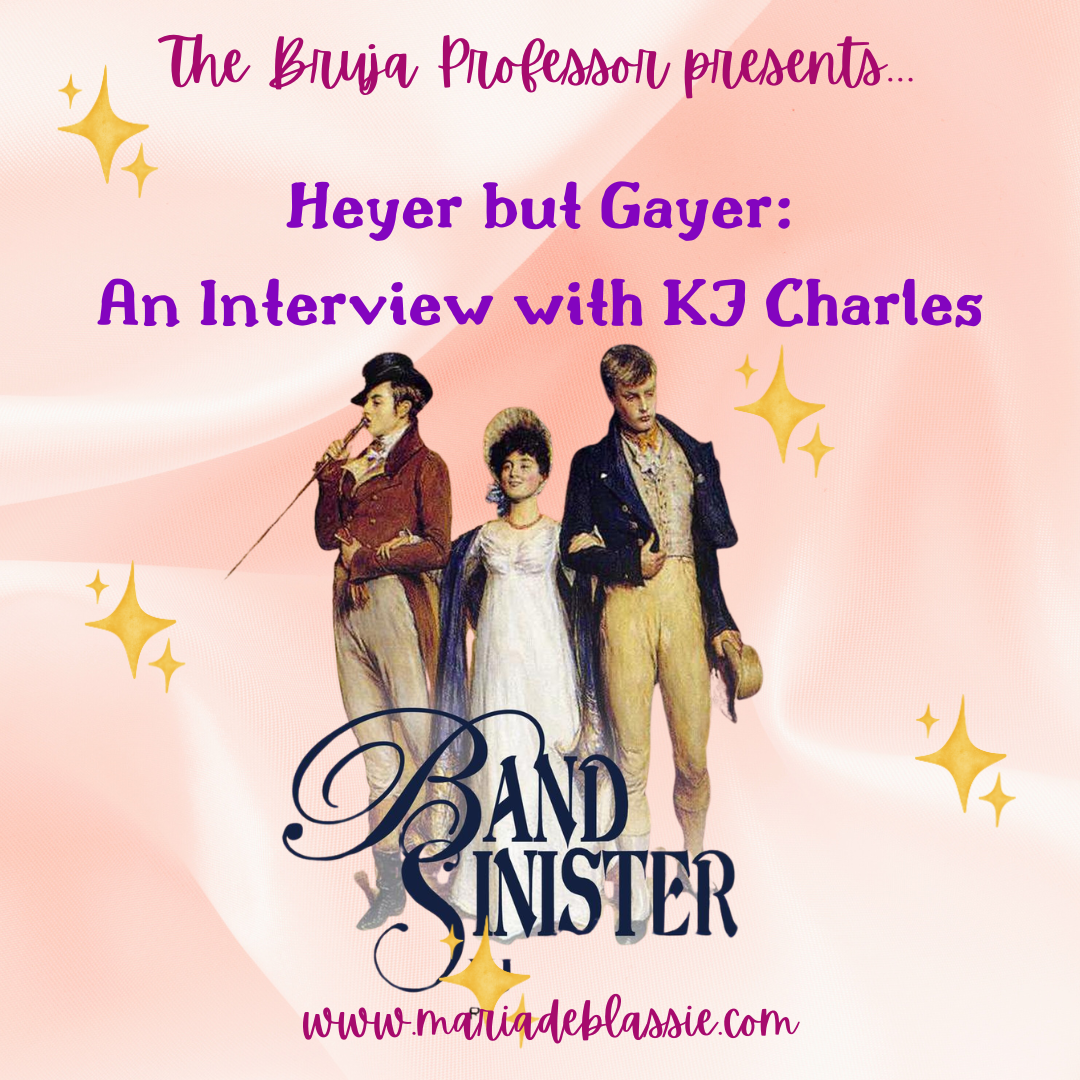
Heyer but Gayer: An Interview with KJ Charles

One of the many reasons why I love teaching and writing is that I get to meet a lot of wonderful creators and share their worlds with my students. I was fortunate enough to interview KJ Charles for my historical romance novel class. We are reading her book Band Sinister (2018). Do yourself a favor and read this lively romance that is often a class favorite. But before you do, check out what Charles has to say about writing queer historical romance. It’s a fantastic conversation!

1. Band Sinister is set in the Regency era. What made you decide to set your story in this time period? What drew you to this setting for the novel? Did you do any research for this novel, and, if so, what surprised you most while researching?

This is the story that gave me the tagline “Heyer but gayer” (for which I sadly cannot claim credit, it was a reader’s genius). I grew up reading Georgette Heyer’s Regency novels—marvellously constructed stories, ingeniously varied plots, properly witty dialogue, and relationships which, while mostly chaste, are bursting with sexual tension. Not to mention that in some of her work, there’s a queerness that’s no less present or deliberate for not being in any way spelled out. However, there’s also antisemitism, hideous classist snobbery, and an entire whitewashing of a period. Talk about a problematic favourite. 

Band Sinister was me trying to write a Georgette Heyer novel that was on-page queer, didn’t exclude people of colour, and offered a happy ever after for more people than just one man, one woman. It’s a Regency because Heyer basically invented the Regency romance.

I very much set it in Romancelandia, unusually for me: I usually like to riff off real specific locations, but this one felt it wanted to be in a fictional village. I did, however, do a deep dive into the history of extracting sugar from beets. This sounds silly (beetroot is one of those perennially comical words), but it was highly political. The British controlled the trade routes from the sugar cane plantations worked by enslaved people; Napoleon funded a French sugar beet industry in order not to be dependent on British sugar; a European supply line for sugar helped in the push to boycott the products of slavery. 

2. What historical constraints (class, gender, sexuality, religion, law, reputation, money) most shaped the protagonists’ choices—and which were you most excited to dramatize?

Ha. All of them in different ways, which was why it was fun to do a large cast! 

In the end, what shapes the plot most is probably gender inequality, in that the events of the plot are put in motion by social constraints on and systemic injustice towards women. Mrs. Frisby can’t escape an unbearable marriage by divorce, so she runs away with Philip’s brother, staining her daughter’s reputation, leaving her children in the hands of their inadequate father, and setting off the events that led to Philip’s brother’s death and Philip inheriting his title. (Not to mention that Philip’s mother would have divorced Sir George Rookwood long before Philip’s birth, given a choice.) If Guy and Philip’s mothers had been permitted to leave their unhappy marriages at will, everything would have been dramatically different. 

Plus, Amanda is socially reviled for having a sexual appetite outside marriage, making her deeply vulnerable to any further hint of ‘immorality’ in staying under Philip’s roof, and Aunt Beatrice is an oppressive villain to the Frisbys largely because she’s afraid of Mrs Frisby and Amanda’s disgrace becoming contagious to her own daughters—who are also, of course, dependent on marriage for prosperity. And Amanda’s writing career, of course, reflects a relatively new and exciting way women could claw themselves some financial freedom despite the constraints of gender and class.

So the social and economic constraints on all these women have a direct impact on the situations and choices available to Philip and Guy, because patriarchy harms everyone, and that’s even before we get into queerness in a patriarchal system.  

(See also: Corvin’s terrible reputation as a rake comes about because he ‘ruins’ a female friend at her request to help her escape an unwanted marriage; the social and professional pressures that affect Sherry’s gender presentation.)  

A large part of what I wanted to do in this book is show a safe space in action (I think this is why it’s usually referenced as my most comforting book), and members of the Murder operate under pretty much all the constraints you mention in the question—race, religion, class, sexuality, gender. It doesn’t escape my notice, however, that the Murder can only exist as it does because of Corvin and Philip’s inherited wealth and gender/class privilege. 

3. Band Sinister is set in a period when queer desire existed but was not publicly legible in modern terms. How do you approach writing queer lives in a historical context without imposing contemporary identity labels?

Well, things exist even when we don’t have names for them, and modern conceptions are unlikely to represent a complete and sufficient truth about human nature, any more than past conceptions have ever managed to do so. 

For example, I didn’t want to explicitly define Sherry as a trans man, or genderfluid, or agender, or indeed a cross-dressing cis woman, though readers are welcome to draw their own conclusions from the text. And the reason I didn’t want to do that is, we have plenty of examples in the historical record of people not living as their birth-assigned genders, where we simply don’t know how they felt about themselves or what modern label they might adopt if they had the opportunity. What’s important is to recognise that people who defied social gender/sexuality norms were there, they existed, they carved out space to live in ways they wanted as far as they could, often with remarkable courage and ingenuity. 

Of course, labels can be a huge help to people who want identity and community. But although Guy doesn’t have ‘I’m gay’ available, he does have an entire history of male-male relationships depicted in his classical studies, plus the practical examples of same-sex and/or non-conforming love within the Murder--and we know that a lot of queer people in the past were able to benefit from existing communities and established tradition. 

And in the end, labels are super useful shorthand, but they aren’t the same thing as character work. In a modern book I might call Corvin a pansexual open polyromantic (for example), but I would still have to work through what it means in practice that he is attracted to literally everybody while having no desire for exclusivity in sexual relationships, and show how that intersects with John and Philip’s preferences and desires, in order to make the core Murder’s entanglements a working part of the plot and character growth.  

4. How did you think about consent and power differences (gender/class/reputation) in a historical framework while still meeting modern reader expectations?

Consent is one of those areas where I feel that human nature is probably constant. When I see comments like “People didn’t think sexual consent was important,” it strikes me as very like “People didn’t think slavery was wrong”: I’m going to need a definition of who counts as “people” in those sentences.

In Philip and Guy’s relationship, consent is crucial because of the power differential: Philip is wealthy, titled, socially secure, sexually experienced, used to doing as he pleases, and has powerful friends who give him confidence in living as a queer man. Whereas Guy is a powerless, isolated, anxious virgin in an oppressive society, whose sister is helpless under Philip’s roof. Even outwith a modern framework of affirmative consent, it doesn’t seem unreasonable to me that a decent human being who cares at all would realise Guy needs a sense of control and confidence in order to enter into a relationship. Getting him to find his voice—or, as we would now say, give affirmative consent--is absolutely part of that.

I wrote a blog post on consent in romance, which breaks down the lengthy consent scene and gives my thoughts on how to use consent.

5. How does chosen family operate alongside—or in tension with—biological family in the novel?

It’s very much a book about chosen family, in that of the five most important characters (Philip, John, Corvin, Guy, Amanda), four come from catastrophically failed families of origin and one from an externally destroyed one (John’s enslavement). Both sets (the Murder and the Frisbys) have had to learn to rely on one another in the absence of parental figures, and it’s clear that none of the five would have had a good life without the mutual support. 

Ultimately, this is a book about supporting one another. That’s the tension in the title: a band (or bar) sinister denotes illegitimacy, an offence against the traditional family, but banding together is what lets excluded people survive—even if it gets them the opprobrium of normative society.

6. Where do you see this book sitting in the broader tradition of historical romance—what authors/books were you in dialogue with?

See question 1! Very directly Georgette Heyer. Specifically, this started as a riff on Venetia, which is an m/f romance with the heroine’s bookish brother breaking his leg and being put up in the rakish neighbour’s house. Venetia is a terrific book, but it’s notable that Venetia remains fairly isolated, and her relationship with Damerel, the rake, doesn’t open up her secluded life much—she chooses him in the teeth of society. That’s a common trope in het romance (all for love, and the world well lost), but I wanted love to mean the opposite for Guy. I wanted his love affair to open up his world and bring him wider joys, precisely because so often queer romances in historicals are obliged to remain hidden and secret, and if we’re going around offering wish fulfilment and happy ever afters, they can include a wider world too.

7. What do you love about the (historical) romance genre and why did you choose to write in it? How has your relationship to romance novels changed over time?

My imagination is very firmly set in the past: I’m a great reader of older pulp. I enjoy the research and making stories work within the settings. Also, there is nothing more plot-ruining than a mobile phone. 

I moved from glomming Georgette Heyer, to a job as editor at Mills & Boon, after which I didn’t read romance for years because wow, saturation point, to discovering modern historical romance: the m/m historical romance of Josh Lanyon and Harper Fox, the Black historicals of Beverly Jenkins, the feminist historicals of Courtney Milan, all of which opened my eyes as to what the genre could offer. 

I love how much I learn from historicals, and I really enjoy seeing characters work against the constraints of their time and society. (Obviously, there are plenty of social constraints operating on people now, but those are the ones we live with, and it’s nice to take a break!)

8. What does it mean to claim space for queer stories within a genre so strongly associated with heterosexuality?

Queer romance has staked out its place in the romance world to a spectacular degree over the last few years. Authors like Alexandria Bellefleur, TJ Klune and Alexis Hall and many more are widely available, and not just online: queer romances are taking up serious shelf space. There’s always more work to do, but the window has shifted in publishing towards much more in the way of queer stories—Mills & Boon now do m/m and f/f books in their main lines, which was just not thinkable when I worked there. Nobody should be complacent in our scary times, but I have great faith in publishers’ willingness to do the right thing when there’s money in it, and as Heated Rivalry shows, queer romance sells. 

9. Over the years, I’ve had more students taking my classes specifically because they love romance novels and want to engage with them more seriously. This means we often talk about our favorite themes and tropes and how they’ve shaped us. What’s your favorite trope or theme and why?

I am ambivalent about the whole concept of tropes, tbh. It’s all in the treatment, not the trope itself, and also the focus on tropes in current (TikTok) marketing is to my mind a bit reductive to the genre. An enemies-to-lovers story can be a completely different beast depending on the severity of the enmity, the stakes, the context, and how they get to being lovers. ‘His muffin shop opens next to her cupcake shop’ is not the same in any meaningful sense as  ‘One is a Russian agent and one’s British Counterintelligence during the Cold War’. Equally, I’ve written a couple of road trips which I thoroughly enjoyed doing, but ‘road trip’ has probably a 50% DNF rate in my reading because it can so often be aimless or picaresque in execution. 

All that said, I am an absolute sucker for agonising sexual tension, which can be strung out as long as the author likes with my goodwill.

10. What can people new to romance get out of these books? What do you wish people knew about the genre in general?

I wish people knew just how good the best romances can be: wonderful, compelling stories that give you hope people can do better by one another. It is absolutely the genre of hope, forgiveness, uplift, and we all need that. 

I also wish they realised romance contains multitudes. People are so reductive about the whole genre (“it’s just boy meets girl, boy loses girl, boy gets girl”) and that’s absolute nonsense. Post on Bluesky asking for a romance about pretty much anything (spider gods, Brexit, doors, taxidermy, funeral homes, gay dolphin shifters engaged in a house renovation project) and someone will give you a suggestion!

Guest Contributor Bio

KJ Charles was an editor for twenty years before switching sides to become a full-time author. She has written some 40 books, mostly queer historical romance, some with fantasy. She lives in London with her family and a retired murder cat. 

Recent books include All Of Us Murderers (Poisoned Pen Press, 2025) and How To Fake It In Society (Tor Bramble, 2026) and her craft book on writing romance, Think, Write, Edit, Romance, comes out with Hay House in December 2026. 

Digital flyer featuring Regency-era figures and text promoting an interview with KJ Charles.

The Bruja Professor, a witchy take on literature, the occult & pop culture, is the scholarly sister to Enchantment Learning & Living, an inspirational blog celebrating life’s simple pleasures, everyday mysticism, and delectable recipes that are guaranteed to stir the kitchen witch in you.

If you enjoyed what you just read and believe that stories are magic & true magic is in the everyday…or your next good read, subscribe to my newsletter below for regular doses of enchantment.

Want even more inspiration? Follow me on Instagram and Facebook. Here’s to a magical life!
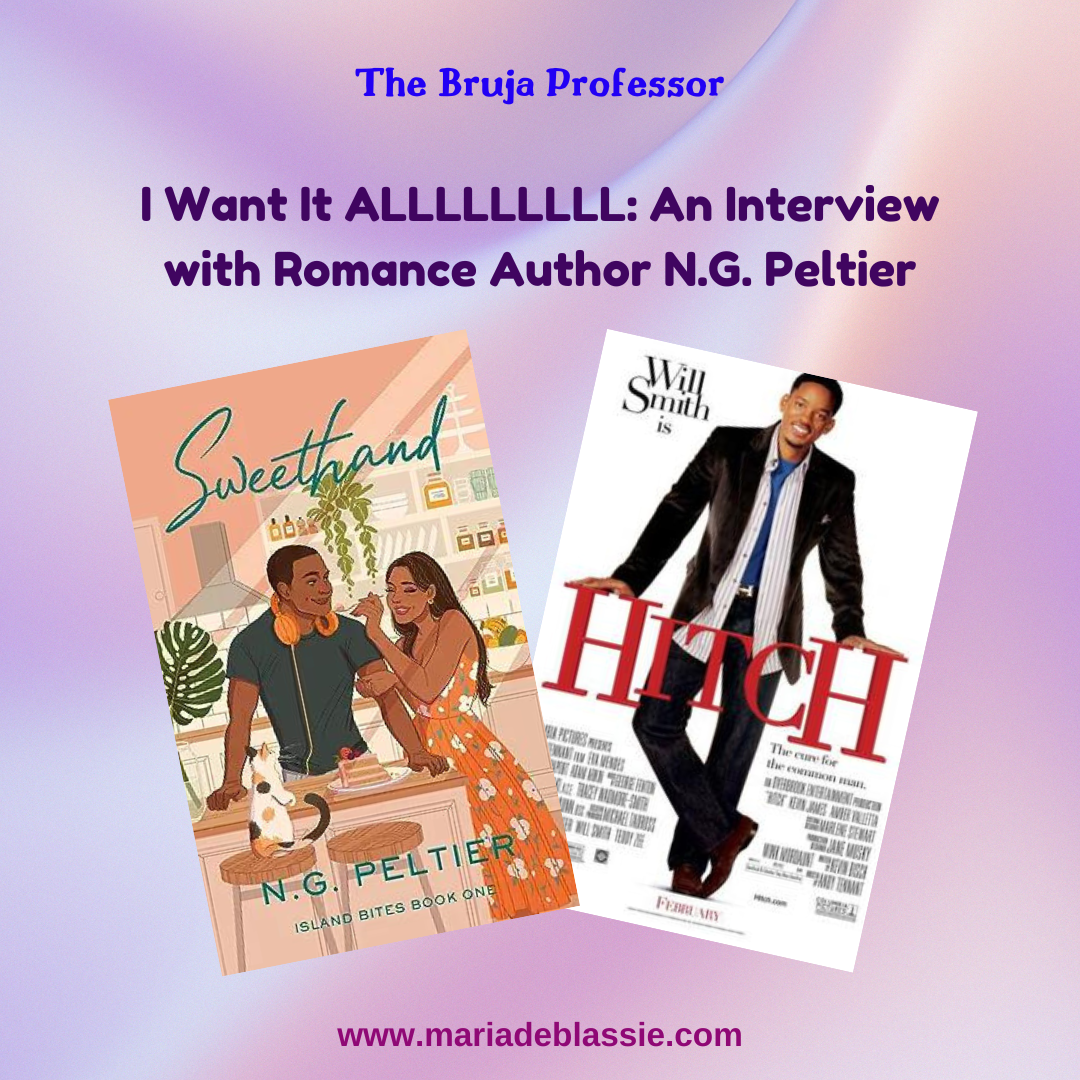
I Want it Allllllllll: An Interview with Romance Author N.G. Peltier

It should come as no surprise, readers, that romance novels made up the bulk of my Emotional Support Books during the pandemic. That goes double for romantic comedies that lightened my heart and made me feel like the world wasn’t always a dark place. One of these Emotional Support Books was N.G. Peliter’s Sweethand, which was not only a feast for the senses but a study in BIPOC and queer joy. I am so excited to teach this book, the first in the Island Bites Series (and devour the second book in the series soon!). It likewise made my year when this fantastic author agreed to let me interview her for my course, “I’ll Have What She’s Having: The Legacy of the Romantic Comedy.” One thing we both agree on when it comes to representation in romantic comedies? WE WANT IT ALLLLLLLLLLLLL!

1. In my classes we talk about the yucks and the yums of various genres. What do you love or think is yummy about romantic comedies?

I absolutely love the awkwardness between MCs in rom-coms. The person could either be sooo awkward that they’re trip up their words or are just downright clumsy so it adds a hilarious element to it. And awkward tension to me is so fun to read/watch and write! 

2. What parts of the genre feel yucky to you? Anything you would change about them?

Some things I don’t like about rom-coms and feel really yucky, be it both books or movies, is that sometimes people lean into using bigotry to add the so called funny element. For instance, making fat people the butt of a joke or using a racist take etc. You can make something funny without that. So I would for sure change that about it. 

3. I have to ask: What’s your favorite romantic comedy? Why?

My favorite rom-com movie is HITCH! I can watch it over and over, and I have lol. I know the movie has its issues, of course, but I just love how we have Albert Brennaman, who is set up as this not-very-suave guy who’s juxtaposed with Hitch, who is supposed to be Mr. Expert at this love thing but really when Hitch goes on his dates just he can’t seem to catch a break/get it together while Albert is absolutely killing it in his own messy way. Lol. I just find it so cute and funny. 

My favorite rom-com book is I Think I Love You by Christina C Jones. This is a rom-com book where you will actually be cackling. Some rom-com books aren’t actually funny but CCJ never disappoints! 

4. What inspired you to write Sweethand?

Sweethand actually started off as a YA contemp fantasy romance thing LOL. There were magical elements and everything (maybe I’ll write that story someday with different characters). But I realized it just wasn’t working as I wanted it to so I decided…hmmm why not age everyone up and keep the enemies-to-lovers angle and go from there? I also wanted to have a fun romance set in my island with Trinidadian characters who could remind me of my friends and family. I really also wanted to have a baker heroine and randomly decided to make Keiran in the music biz as I felt their jobs gave them opportunities to interact/clash 😊 

5. Tell us a little more about the inspiration behind Sweethand. What romcom tropes and themes did you want to play with and why?

As mentioned above I definitely wanted to have fun with the annoyance to lovers tropes. Because I looove reading about people who just can’t stand each other for whatever reason but oh noooo they’re attracted to each other. The potential for sexy, fun banter is so great in these scenarios. I also decided to sweeten the pot by adding in another trope I love: forced proximity. These two, their blood already don’t take to each other, as we say here, and now they have to plan a joint wedding party?? Together?? Chaos and disasterrrr.

6. Your story is set on your home island of Trinidad. You’ve also said in other interviews that you rarely see romances set in the Caribbean centering on Caribbean characters. What was it like to write that romance?

It was an interesting experience. Of course, as I wrote it I was enjoying including all the very trini centric things, like local places, our food, dialect, aspects of the culture but on the flipside was the worry that hmmmm is this too Caribbean?? Is it not Caribbean enough?? But then I said you know what??? I’m writing this for me and hopefully readers will love it because in my mind regardless of where it’s set that shouldn’t hinder the enjoyment yeah? Also there are things that confuse me when I read romances set in America and I still manage…like I still don’t understand the education system. Like how old is a junior or senior or sophomore??? I just don’t knowww lol.

7. Similarly, you also center your stories on BIPOC and queer characters who aren’t featured enough in romance stories or romantic comedies. In fact, many of our stories in media are a kind of trauma porn, as I tell my students. What was it like to write a joyful story that centered on these communities? 

The population of Trinidad is mainly made up of people who are afro-trini and indo-trini. Why would I not centre us? It was just a natural thing. These are my friends and family members. The Caribbean is still so sadly anti-queer ☹ but for me I wanted to showcase that love isn’t for one group of people alone. Making Keiran bi and not have that be a whole thing during the story was also a very natural and conscious decision for me. There are joyful romances featuring queer characters who are just living and loving that already exist so I just wanted to add those. And I feel so glad when readers say my book cheered them up or made them happy because that’s really all I want 😊 

8. As you already know, there are A LOT of stigmas associated with the romance genre in genre and the romantic comedy specifically. Why do you think that is?

Hmmm, I think people have this notion that it’s a “feminine thing” so it’s girly and cringy to admit that hey I love/read romance. Which side eye to everyone who thinks so. There are so many different kinds of romance that okay, if rom-coms specifically aren’t your vibe cool, but there’s romantic suspense if you’re looking for something with some action! I love rom coms but I also enjoy action, thrillers, sci-fi, fantasy, animations etc. There are even manga romances out there! Just give it a chance, at least. 

There’s also this notion that romance is not anything of substance or real literature but who gets to even define what real lit is???  Romances can be just fun, fluffy reads or be that as well as delve into deeper, “serious” topics. Just because we’re exploring love and relationships here doesn’t mean it’s not going to be a quality read or won’t be something of substance.

9. What do you think romantic comedies can teach people about life, love, and relationships (you can discuss both the good and bad here)?

Oh, rom-coms for sure let you know that love can happen anywhere and anytime. On the job, at the grocery, at a wedding. With someone you’ve known your whole life. I’ve been in a friends-to-lovers and office romance thing so…it is real hehe. 

One thing some rom coms seem to push over and over is the big grand gesture which while I love in movies and to read please don’t ever do some over-the-top thing to win my back I will be super annoyed lol. I prefer a small private gesture. So here’s where I think we should realize that relationships are so different. You can’t just reuse a move that may have worked on someone before with a new person. Tailor your gestures and actions to who the individual is. 

For instance, for me, I know people think oh for Valentine’s Day I just get my partner the usual flowers and candy cuz that’s what people do. Nope. Get me some books on my wishlist or that very specific thing I’ve been wanting to get foreverrr and I’d appreciate that more. I will always recall when one of my exes just randomly got me this duck puppet thing where when you put your hand in the back and make the mouth move, it quacked “Old MacDonald,” lol. It was so out of the blue??? but I love funny things like that so much. 😉

10. Is there anything else you’d like to add?

I do want add that I want to see more and more rom-coms with underrepresented communities written by persons from these communities. I need roms set in various Caribbean islands. Give us the interracial roms where no one is white. The trans characters being cute and awkward where I’m over here like just kiss already??? Fat leads living their best sexy lives etc. I want it alll.

1. Where can people find you to learn more about your work?

Thanks so much for having me. I’m on Twitter, IG and now Threads as @trinielf. And if you want to learn more about my books check out my website.

Guest Contributor Bio

N.G. Peltier is an anime watching, book reading, video-game playing, story writing kinda girl.

A devourer of words and books from a young age, she enjoys writing romance and creeping people out with the Caribbean folklore stories she grew up hearing.

A Trinidadian born and raised, she currently lives in Trinidad with her mountain of ideas and characters battling each other for whose story get told next.

She is represented by Lauren Abramo of Dystel, Goderich & Bourret LLC

The Bruja Professor, a witchy take on literature, the occult & pop culture, is the scholarly sister to Enchantment Learning & Living, an inspirational blog celebrating life’s simple pleasures, everyday mysticism, and delectable recipes that are guaranteed to stir the kitchen witch in you.

If you enjoyed what you just read and believe that stories are magic & true magic is in the everyday…or your next good read, subscribe to my newsletter below for regular doses of enchantment.

Want even more inspiration? Follow me on Instagram, Facebook, Pinterest, and Twitter. Here’s to a magical life!

RomComs Are All That: An Interview with Romance Author Maya Rodale

Readers, let me tell you something: I was over the moon when Maya Rodale agreed to let me interview her for my course, “I’ll Have What She’s Having: The Legacy of the Romantic Comedy,” and for the Bruja Professor. I love teaching her book, Lady Claire is All That, part of her Keeping Up with the Cavendishes series. In case you didn’t get the hint from the title, the book is based on the teen classic rom-com She’s All That. It’s a delightful historical romp that introduces students to romance novels, fan fiction and adaptations, and the joys of historical romance. Maya was kind enough to chat with me about this book, romance, and the yucks and yums of the rom-com genre. SWOON!

1. In my classes, we talk about the yucks and the yums of various genres. What do you love or think is yummy about romantic comedies?

I love that romantic comedies put me in an emotional space of love, laughter and optimism. I love that they are unabashedly and unapologetically about having a good-hearted good time.  

2. What parts of the genre feel yucky to you? Anything you would change about them?

We can look back at Rom Coms from earlier times and be squeamish or even horrified by what we thought was romantic, or the dynamics between people or whatever. I think of the movie Knocked Up, which I really enjoyed at the time but now I have questions....

On a personal note, while I love grand romantic gestures in rom-coms, I would be horrified if that happened to me IRL. 

3. I have to ask: What’s your favorite romantic comedy? Why?

My favorite romantic comedy is my favorite movie—Roman Holiday. I love it because you can really see the heroine’s journey of self-discovery happening through the romance. I love her rebellion against what is expected of her. I love her joy and pleasure she finds all day. I love that her hero is thrilled to be there, holding her hand. The whole story is kind, it’s funny, it’s magical and you can feel it. Book #2 in the Keeping Up with the Cavendishes series, Chasing Lady Amelia, is based on it. 

4. What inspired you to write a retelling of She’s All That set in Regency England? What is it about that movie that captured your imagination?

Confession: I don’t think I had seen the movie before I decided to write a Regency version of it! Of course I was familiar with it, being a teen in the 90s, but for whatever reason, I had yet to see it. But watching it is the best kind of “work” and “research” that I do. The entire Keeping Up With the Cavendishes series is based on rom-coms and your next question will allow me to answer why I picked this movie...

5. Tell us a little more about the inspiration behind Lady Claire is All That. What romcom tropes and themes did you want to play with? How did the Regency setting change the original high school-set story?

First, I think the Regency is so very high school! 

I knew I wanted to write a very smart heroine based on Ada Lovelace, the first computer programmer. Readers were asking for her ever since my novel, The Wicked Wallflower, which drew a lot of inspiration from the work of Charles Babbage and the computer he invented. 

I also knew I wanted to write a “dumb” hero. So many romance heroes are the tallest, the smartest, the richest, the hottest, etc. and I was a little bored of writing that. I wanted the challenge of writing a hero who wasn’t the sharpest tool in the shed, but who still had a lot to offer. 

And I had major feminist angst about the whole “makeover” plot and “make her popular” plot that I wanted to play with. 

She’s All That provided the perfect framework to play with all those ideas. 

6. I talk with my students about how many romance authors were inspired to become writers, in part, because of the 80s/90s/00s romantic comedies they grew up watching. Was that the case for you?

Sure! I LOVE those movies and then they stopped making them, so I turned to romance novels instead. And when I read those faster than they could be published, I had to start writing my own ☺ 

7. I also discuss with students how fanfic has really changed the way we think of stories, AND YET, in many ways, most writers are writing fanfic, trying to capture the essence of stories they love. Is that the case for you?

Absolutely. I used to play guitar, and I would try writing songs that sounded like an artist I loved and...my songs always came out wildly different. But it was a wonderful creative exercise. What do I like about it? What emotional notes are being hit, and in what order? What are the ingredients here? 

FanFic is the same, I think. The fourth book in the Keeping Up With the Cavendishes series, It’s Hard Out Here For a Duke, is essentially fanfic to the Meredith and Derek relationship on in season 1 and 2 of Grey’s Anatomy. I actually used the name Meredith Green as a placeholder in Book #1 and it went to press before I could change it so...I was stuck with it! 

8. As you already know, there are A LOT of stigmas associated with the romance genre in genre, and the romantic comedy specifically. Why do you think that is?

Well, I wrote a whole book about this. ☺

Short answer: I think culturally we have anxiety about women and other marginalized groups unapologetically experiencing love, pleasure and empowerment—and then being rewarded with a happy ever after. Romance novels and romantic comedies are all about that, unapologetically so. 

9. What do you think romantic comedies can teach people about life, love, and relationships (you can discuss both the good and bad here)?

A really good romantic comedy shows how the love inspires or agitates someone to really blossom and become their truest version of themselves. I love that. 

I could write A LOT here about how they teach us a script and a language for courtship, romance and love. Or what to look for in a partner. How a partner should treat someone they love. How we get to vicariously experience emotional highs and lows and practice feeling emotionally vulnerable. How we can overvalue grand gestures. 

Most of all, I think they remind us that love and life can be fun and funny and full of heart and emotion and we can take pleasure in that. That is no small thing.

 10. Is there anything else you’d like to add?

What a great list of questions, thank you!

11. Where can people find you to learn more about your work?

The best place to find me is www.mayarodale.com. I’m also on Threads and Instagram as @mayarodale and on Substack

My most “rom com” romance novels are: Lady Claire is All That, Lady Bridget’s Diary, The Wicked Wallflower, Seducing Mr. Knightly and the contemporary When Jane Met Duke. And in Dangerous Books For Girls: The Bad Reputation of Romance Novels, Explained I talk about why it all matters. 

Guest Contributor Bio

Maya Rodale is the best-selling and award-winning author of funny, feminist fiction including historical romance, YA and historical fiction. Reviewers and readers have noted her “signature wit and banter” (Entertainment Weekly) and declared her novels to be “endlessly entertaining” (Booklist), “funny, heartfelt and lovingly crafted” (Library Journal), “certain to delight” (Publisher’s Weekly), “energetic and bold” (Kirkus), and “absolutely a ton of fun to read” (Smart Bitches, Trashy Books).

A champion of the romance genre and its readers, she is also the author of Dangerous Books For Girls: The Bad Reputation of Romance Novels, Explained. Maya has reviewed romance for NPR Books and has appeared in Bustle, Glamour, Shondaland, Buzzfeed, The Huffington Post and PBS. She began reading romance novels in college at her mother’s insistence and has never been allowed to forget it.

Images of Lady Claire Is All That book cover and She’s All That movie poster.

The Bruja Professor, a witchy take on literature, the occult & pop culture, is the scholarly sister to Enchantment Learning & Living, an inspirational blog celebrating life’s simple pleasures, everyday mysticism, and delectable recipes that are guaranteed to stir the kitchen witch in you.

If you enjoyed what you just read and believe that stories are magic & true magic is in the everyday…or your next good read, subscribe to my newsletter below for regular doses of enchantment.

Want even more inspiration? Follow me on Instagram, Facebook, Pinterest, and Twitter. Here’s to a magical life!