When I was a young girl, it was common practice to leave out offerings to the faeries.
I grew up reading fairytales and the works of Brian Froud, and between those and Tolkien’s The Hobbit, I was convinced that the world was rather more magical than we gave it credit for. In fact, I firmly believed that we lived in our very own Shire. And yes, I did spend a summer trying to toughen my skin so I could have thick hobbit feet—who needs shoes?
My younger sister and I built gorgeous, rustic gnome houses in our bedrooms that ran across our bookshelves and looked very cozy, indeed. She, an artist even then, built glorious fairy homes in the garden with nothing but mud, sticks, and her imagination. We would dance out under the stars in the summer and look for magical creatures beneath every flower head and under every rock. We left offerings—sticks, feathers, pistachio shells—to whatever spirits lived in the wild wood of our family garden. My other siblings and I spent afternoons figuring out the right consistency between water and dirt for the perfect mud pie, or listening to our mother explain that some plants could be turned into tea.
In other words, dear readers, I grew up in a home of magic and whimsy.
These things were just as important as learning the practical skills of reading and cleaning house, knowing basic math, and mowing the lawn. A well-balanced life comes from the grounded energy of our daily work and studies—and a healthy respect for the ephemeral, joyous things that make life magical.
It took me a long time to realize that not everyone was raised this way. You didn’t grow up making fairy houses and looking for gnomes in your garden? You didn’t make potions out of sticks and torn-up plants? You didn’t count the many crows nesting in your neighbor’s tree and wonder at what secrets they kept?
How sad!
It seems a terrible thing to have no sense of whimsy. How does one cope with the difficulties of life without it? How does one figure out what is right and beautiful and wonderful without it? Some things I will never know—or understand.
As I’ve aged, I’ve brought this sense of magic into my life and into my home. It’s literally all I write about! Well, that and its twin flame: the gothic (and, of course, whimsigothic). But I’ve noticed, particularly when times are hard, that I return to whimsy to soothe my soul.
I’ve found refuge in decorating my home for spring. Wildflowers on the mantle. Rose-strewn linens on my bed. A tablecloth speckled with garden motifs. I sip chamomile tea from mugs dotted with strawberries as I swan around the house in an oversized kimono, sweeping away the dust of winter and ushering in good intentions for the warmer seasons.
I fill my patio garden with as many brightly colored plants and fresh herbs as I can—to welcome the fae folk, of course, and honor the medicine each green, growing thing offers.
Later, I eat olives from a tiny plate painted with lemons, while sipping wine from a pink wineglass I found at a vintage store, and paint my nails a sparkling lilac to match the flirty flowers that bring me joy this time of year.
My wardrobe, too, looks like something out of a fairytale, or as someone once told me, “just how I thought a bruja professor would dress.” Velvets. Soft patterns and rich jewel-tone colors. Scarves aplenty. Jewels and perfumes and many lovely things to soothe the senses.
I knit blankets so large and long they border on absurd… and a touch enchanted. I gather herbs from my garden to craft medicinal salads and tisanes, as any kitchen witch worth her salt should.
Whimsy, in other words, is alive and well in my life.
I even find touches of it in my classroom. This semester, we read Beverly Jenkins’ Forbidden, a personal favorite of mine, in my historical romance class. I can never read this book without craving marmalade. I told this to my students and discovered many of them had never had marmalade. So I did the only thing any sensible educator should do and threw a marmalade party.
We ate shortbread cookies and dark chocolate slathered in marmalade and drank lemonade (because Rhine goes shopping for lemons for lemonade and runs into Eddy buying oranges for marmalade), all while discussing the symbolism of this jam in Jenkins’ novel. It then led to a powerful student discussion about the politics of passing in this romance and how it affected us, as the majority of my students, like myself, are white-passing or have an othered identity that isn’t always visible. The conversation was frank, open, and generous about the various marginalized identities the majority of us carry inside us.
Whimsy, in this instance, became a vehicle for community building and talking about difficult topics in an open and curious way. Like Eddy’s marmalade in Forbidden, we took what might be an often discarded conversation and turned it into something fruitful and delicious.
I found it again in a new collaboration with my fellow book witches of The Carterhaugh School of Folklore and the Fantastic. Sara and Brittany are working on a fantastic new course, Me & The Moon: The Folklore of Tarot, and I’ll be offering a workshop titled The Cards That Choose Us: Tarot and Personal Story Making. It’s about affinity cards, or the cards that keep coming back time after time and have special medicine for us. Now, I didn’t tell Sara and Brittany that my affinity card is the Queen of Wands… until they rolled out their free tarot workshop on exploring folklore and fairytale through the cards. Guess what it was called? The Queen of Wands! Of course this queen would speak to my fellow witches as much as she did to me. It was a lovely bout of synchronicity that filled my heart with joy.
The message was clear: Magic is afoot!
Even my social media algorithms know I love magical living, because I am inundated with reels and images about the importance of whimsy. I’m not mad about it.
Whimsy is a way of life that allows for hope and magic, even in dark times. It’s a way of creating space for joy and ease, even when life gets hard. It’s also a way to push back against consumerist culture and the daily grind that says we are only worth as much as we produce.
Yeah, whimsy is political. Especially for those of us with marginalized identities. Joy is the first thing the system tries to take from us. Cultivating wonder and delight protects us from the horrors of systemic oppression. Better still—it helps us dismantle it.
And that’s why whimsy is sacred.
It nourishes us. It fuels us. It allows us to dream bigger and find wonder in the most mundane of circumstances. It connects us to something deeper than ourselves—the natural world, the universe, the ephemeral luminosity that surrounds us.
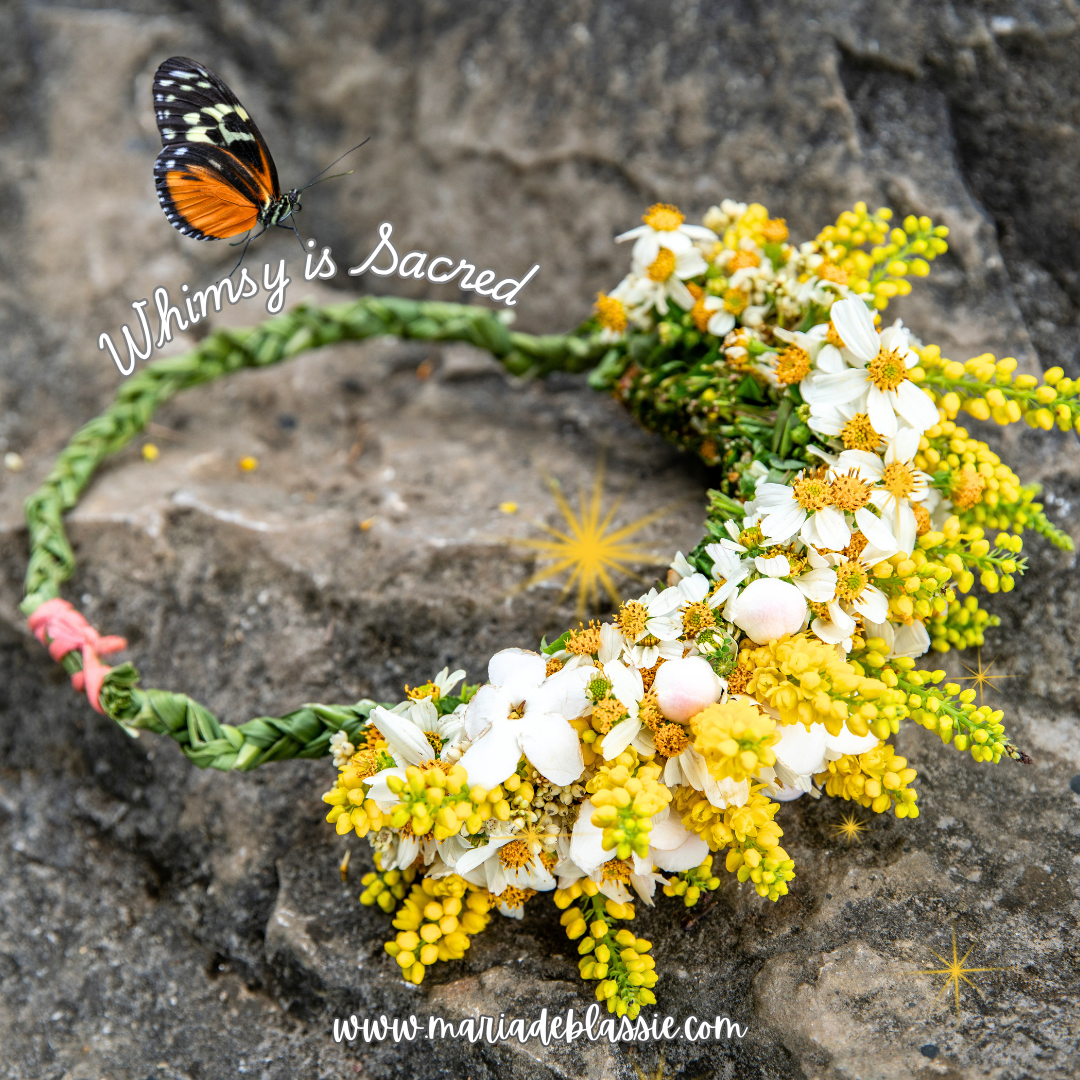
So here, on the eve of Beltane, I invite you to flirt with whimsy. Dance under the flower moon. Wear flowers in your hair. Leave out offerings to the fair folk. Allow yourself to be more than burdens and heartache.
Leave the door open for joy, magic, and delight.
Enchantment Learning & Living is an inspirational collection of musings touching on life’s simple pleasures, everyday fantasy, and absolutely delectable recipes that will guarantee to stir the kitchen witch in you. If you enjoyed what you just read and believe that true magic is the everyday, subscribe here.
Want even more inspiration to make your dream life a reality? Follow me on Facebook, Pinterest, and Instagram. Thanks for following!