There are few things more magical, as an educator, than seeing a former student living their best life. This guest contributor was a CNM student in my fall 2019 Introduction to Literature class….with a gothic twist because what kind of other literature is there?!?! I kid…mostly. It was one of those numinous classes where we all bonded, had loads of fun, learned so much from one another, and practically broke out into a group hug at the end of the term. Now, I find that Kristen has gone on to become a fantastic scholar, healer, and Executive Director of the International Gothic Literature Society, which does not surprise me in the least! She was always so hard-working, motivated, and on fire for gothic literature in my class. Here, she shares her powerful ideas on gothic psychology. Enjoy!
“One does not become enlightened by imagining figures of light, but by making the darkness conscious.” -Carl Jung
Jungian psychology, a discipline that examines aspects of the conscious and unconscious mind, has long borrowed stories from myth and fairy tales to examine the nuances of psychological architecture. Few scholars have deeply explored the Gothic through a Jungian lens thus far, and I would like to invite you to travel between these two worlds with me. The Gothic, where ruin, mystery, and revelation have long shaped symbolic vocabulary, emerged as a product of the Enlightenment and offers us an exploratory landscape for what rational thought could not express. The world of Jungian depth psychology, which comes centuries later, offers its own theories on how to engage with the cast-off, shadowed, and haunted terrain of the mind.
The beauty of engaging with both disciplines together is that we have the opportunity to not just explore story for the sake of entertainment alone, but to bring forward an archetypal analysis that allows us to move more deeply towards Jung’s ultimate goal - individuation. This movement towards wholeness integrates not just the radiance of clear-eyed consciousness, but asks us to listen to the darker whispers within, daring to peer into forbidden rooms and shadowed corridors that lie in hidden places of the unconscious mind. These unconscious regions speak through rage, jealousy, self-sabotage, grief, or shame and cry out to be more deeply integrated. As they begin to surface, we often repress or attempt to turn a blind eye to satisfy a part of ourselves that would never want to acknowledge that something so unholy exists within our minds.
The Gothic, not just an aesthetic of darkness, has long been a form of cultural shadow work. What emerges within myth, folklore, and literature reflects aspects of both personal and the broader collective unconscious. What remains in the unconscious remains in shadow. Paraphrasing a metaphor I once heard from James Hollis, Jungian analyst, if the mind is a house, the conscious mind is where you live in the well-lit upper floor. We are keenly aware of what goes on here. Being avoidant of the shadow is like hearing odd creaking and groans in the basement and choosing to ignore them. For only so long can we pretend that we don’t hear those basement rumblings before it will make its inevitable, unbidden, spectral emergence.
For example, Charles Dickens’ A Christmas Carol, the classic gothic-inflected tale of Victorian winter, reveals both the collective and personal unconscious at work. The moral blind spots of industrial progress, exploitation, and poverty expose the shadow of the era through the novel; the Victorian social context itself is demonstrative of the collective shadow. On the level of the personal unconscious, Scrooge becomes a study of the disowned psyche, with his ghosts serving as emissaries of his personal repressed material. We feel, within the affective liminality of the story, where elements of our own shadowed nature pursue transformation when called forth by these visitations.
The Ghost of Christmas Past reveals the danger of dissociated memory, The Ghost of Christmas Present demonstrates the psychic dissonance inherent in a lack of empathy, and the Ghost of Christmas Yet to Come reveals the terror of the unexamined, unlived, and unredeemed life. Through these hauntings, the psyche stages its own transformation. As readers, we are confronted both culturally and individually with the psyche’s emotional and moral reckoning that refuses to remain buried.
Both Jungian analysis and the Gothic share the necessity of confronting that which is continually resurrected and drains our vital life force (e.g., Dracula), the sometimes doublesidedness of human nature (e.g., Jekyll and Hyde), and honoring the descent into the dark recesses of the labyrinthine mind. Jungian alchemy even offers us a space to honor this psychic process as we must all pass through the nigredo - the first and essential, darkest space on our journey to individuation. Jung explains that in order to fully know oneself, this nigredo, “blackening,” must occur. It is a necessary confrontation of the repressed, darker, and disowned parts of a human being’s psyche. The experiential dimension of this stage often resembles much of what we find in the Gothic. In life’s terms, it looks like our grief is finally being voiced - the surfacing of long-repressed affect, or the “good girl” acquiescence with no boundaries turning into a clarifying rage - the collapse of false innocence into a stage of empowered shadow. When the truths we avoid break through, or when the identity that the ego clung to begins to crack and fall away, we find ourselves face to face with this alchemical process.
Six months ago, an autoimmune flare dismantled the identity I had built over years in research. I was unable to continue in a body that had carried me through conferences, a fellowship, and long hours in a prison system studying psychopathy. The scaffolding of my health, once robust, had collapsed, leaving me grieving the lost trajectory of my career and in dark psychic terrain with no clear sense of how I could move forward from that point. In this condition, I used to tell my husband, only half in jest, “I’m putrefying”. To anyone outside of the Jungian or alchemical context, this phrasing sounds quite grim and dramatic. In truth, it often was - my heart was racing, my breath was thinning, and I was constantly disoriented and fatigued, but the promise of the putrefactio (a sub-stage within nigredo) is something ancient and wise. The deep intuitive knowing that if we allow ourselves to listen to and confront the darkness, to sit with its lessons, a glimmer of hope will arise. The nigredo always precedes transformation. What is old and no longer serves must disintegrate and compost itself so what is more authentic can emerge. The blackening gives way to the washing, the washing to the dawning, the dawning to the reddening - the return of vital, embodied life.
The Gothic lives in service to archetypal gestures of the psyche seeking wholeness. It portrays through its symbolic dramas the shadow that psychology would later name. The Jungian lens fleshes out the deeper meaning of these tropes that were exiled from consciousness under rationalism - the repressed, the feminine, the emotional, the spiritual, the uncanny, with both sharing the commonalities of symbolism and affect.
The symbol of Jacob Marley’s ghost in A Christmas Carol, Shirley Jackson’s haunted house, or proto-gothic Bluebeard’s locked room serves as literary flourish, yes, but it also communicates the emotional and psychic truths of our individual and collective repressed unconscious. The atmosphere of affect gives these truths room to breathe. Its stirred emotion is salient information that sends up a flare signal and says, “Stop here and listen. This felt sense has meaning.” As the compass of the unconscious in Jungian psychology, we feel this affect deeply in the Gothic as dread, terror, awe, or unease. If symbol is the language of the psyche, affect is its emotional truth that asks us to “dig here” for the alchemical treasure. The Gothic and Jungian perspectives together remind us that there is not just wisdom, beauty, and power in acknowledging the shadow, but in consciously illuminating it from within. Or, said in another way by Jung himself, “where fear is, there is your task.”
Influences
Jung’s Aion (Collected Works, Vol. 9ii), Mysterium Coniunctionis (Collected Works, Vol. 14), and Psychology and Alchemy (Collected Works, Vol. 12); James Hollis’s Jung Platform lecture on shadow work; Gothic classics (Dracula, Jekyll & Hyde, A Christmas Carol, The Haunting of Hill House); and traditional Bluebeard folklore.
Guest Contributor Bio
Kristen R. Estill holds a summa cum laude B.A. in Psychology with a minor in Health, Medicine, and Human Values from the University of New Mexico, where she conducted two years of neuroscience research as part of an NIH-funded biomedical grant. Her current work bridges science and soul, blending empirical insight with archetypal, psychological, and narrative frameworks. Kristen offers mentorship, educational resources, and contemplative offerings through her company, SoundMindScience, and she serves as the Executive Director of the International Gothic Literature Society, a public-facing scholarly initiative dedicated to exploring the Gothic tradition through collaboration, analysis, dialogue, and lectures. Her interdisciplinary work with the Gothic examines its symbolic and psychological dimensions as a lens for shadow integration and depth psychology. She also offers guest lectures on these topics as well as mindfulness meditations on the Insight Timer platform. More information on the International Gothic Literature Society can be found at gothicliteraturesociety.com.
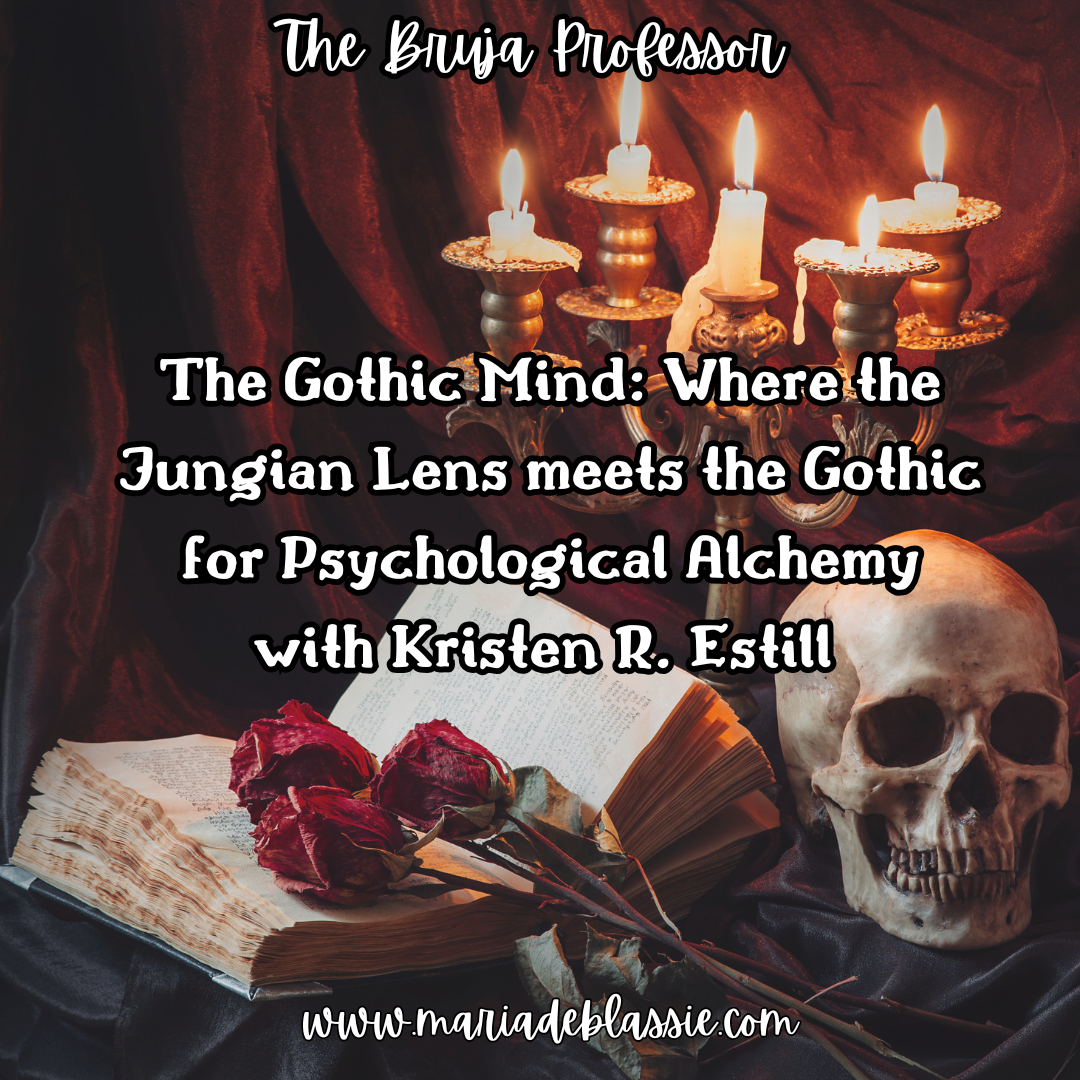
Alt-text: Lit candles, opened book with dried roses, and a skull on red velvet with Gothic-themed text.
Transcribed Text: The Bruja Professor, The Gothic Mind: Where the Jungian Lens meets the Gothic for Psychological Alchemy with Kristen R. Estill
The Bruja Professor, a witchy take on literature, the occult & pop culture, is the scholarly sister to Enchantment Learning & Living, an inspirational blog celebrating life’s simple pleasures, everyday mysticism, and delectable recipes that are guaranteed to stir the kitchen witch in you.
If you enjoyed what you just read and believe that stories are magic & true magic is in the everyday…or your next good read, subscribe to my newsletter below for regular doses of enchantment.
Want even more inspiration? Follow me on Instagram and Facebook. Here’s to a magical life!