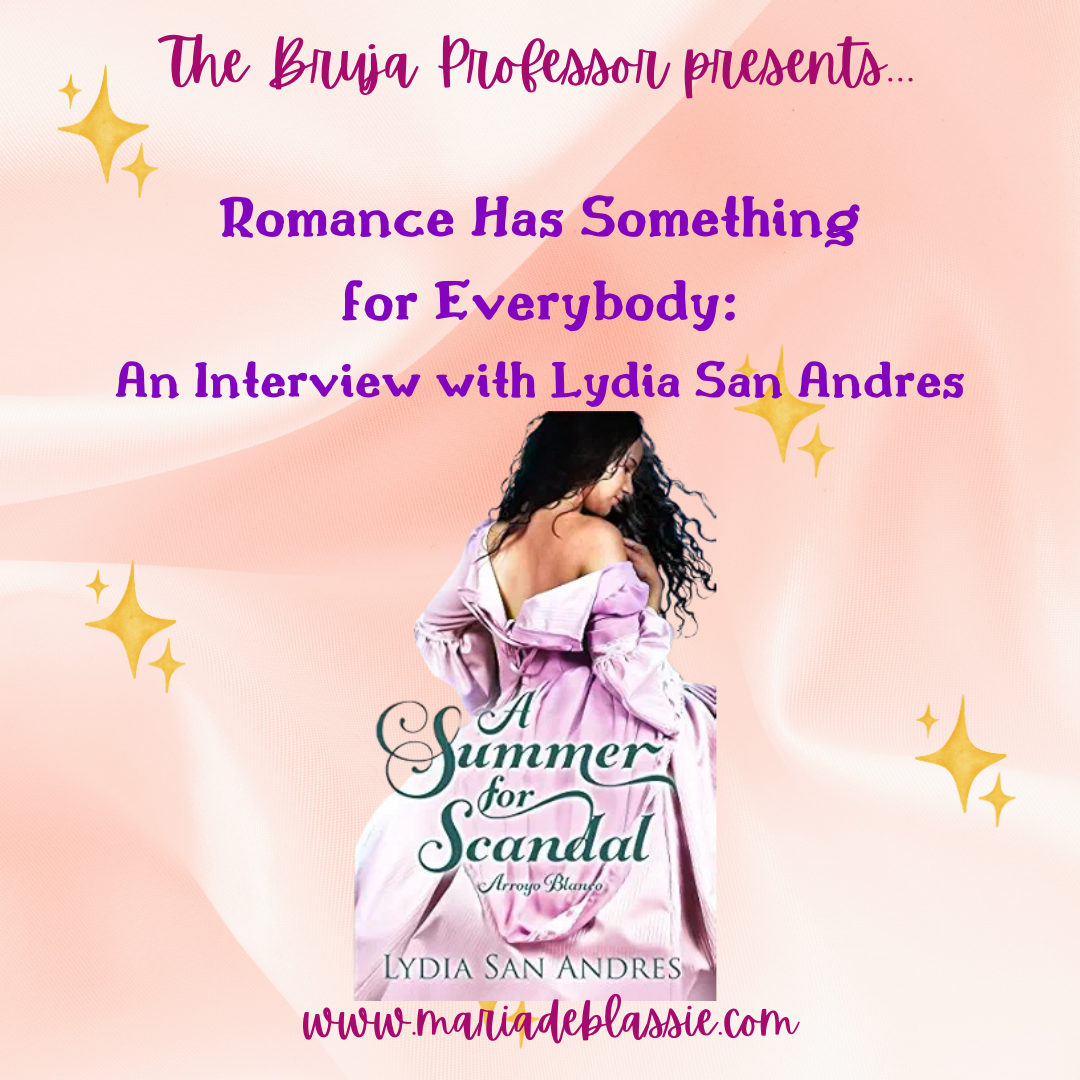
A Summer for Scandal (2015) is one of the first historical romance novels I read that centered on people who looked like me. It was refreshing and delightful to see brown people centered in a story that had a happy ending. We often speak in my class about the importance of seeing yourself represented in stories with HEAs, so I knew I had to teach this novel when I designed the class. It also has some of my favorite romance novel tropes, including lady authors and secret identities. I was lucky enough to interview the author, Lydia San Andres, for my historical romance class. I hope you enjoy our lovely conversation and read her books. They are wonderful!
1. A Summer for Scandal is set in 1911 in the Spanish Caribbean in the fictional town of Arroyo Blanco. What made you decide to set your story in this time period? What drew you to this place for the novel? Did you do any research for this novel, and, if so, what surprised you most while researching?
After finishing a master’s degree in Art History, I began working as a research associate for an academic entity in the United States that studies Dominican history. Since I was the only member of the team who lived in the Dominican Republic, I was the one tasked with delving into the National Archives in search of whatever documents were needed for the projects their historians and sociologists were working on. I was so captivated by archival research that I started visiting the archives on my days off, purely to devour all the primary sources there. As I paged through digitized newspapers and magazines and scrutinized fragile handwritten documents, I began to get such a clear picture of what life in the late 19th and early 20th century was like here in the Dominican Republic that I knew I had to set a book there.
Around this time, I had just completed a Master’s in Art History and written a thesis on the history of poster design in the Dominican Republic. The months-long research for that had also involved delving into archives and sorting through—I’m not kidding—garbage bags full of posters and hand-painted signs. These had helped paint an even clearer picture.
Back then, I was mainly writing fantasy. I saw historical settings as an opportunity to engage in something similar to worldbuilding, especially considering how patchy the historical record in the DR can be when it comes to the smaller details that make up everyday life. (Most of the documents that survive are governmental or the newspapers and magazines I mentioned above, and I haven’t been able to find any personal letters or diaries.) As I began to write A Summer For Scandal, I took the worldbuilding aspect even further and decided to invent my own Caribbean island as the setting, mostly because of the freedom it gave me to make things up.
I narrowed my range of research from 1900 to 1915, because in 1916, the Dominican Republic was occupied by the United States, and daily life changed drastically. I was surprised to find just how modern life was in that first decade and a half. There were advertisements for Colgate toothpaste in magazines, as well as many other brands we still use to this day.
2. What historical constraints (class, gender, religion, law, reputation, money) most shaped the protagonists’ choices—and which were you most excited to dramatize?
In this book, it was Emilia’s gender and her need to make money to support her family while upholding society’s ideals of how a woman should behave in order to keep her reputation—and therefore her marriage prospects—intact.
Throughout history, women have always worked outside the home. In the early 20th century, especially with the growing appetite for industrial manufacture, women were joining the workforce at unprecedented rates. In the Caribbean, where industrialization wouldn’t come until later, there weren’t as many avenues of work for middle-class women outside of teaching and needlework. Emilia has a day job as a typist at an office, but she still needs to write on the side to make ends meet. (And probably because doing something that scandalous thrills her!)
3. In my classes, I often talk about the importance of people with historically marginalized identities seeing themselves in narratives with a guaranteed HEA. What does it mean to write Latine romance to you?
When I began writing A Summer for Scandal sometime in 2014, I hadn’t been able to find any historical romances featuring Latine people and written by a Latine author. I hesitate to state that there weren’t any—if there were, they were very hard to find.
Maybe it’s because I’ve lived in the Dominican Republic for most of my life, but I had this overwhelming desire to open the door to my home and bring other people inside and show them around. Growing up, it was very rare to see my country represented in American media at all—and the few times it was, it showed an incomplete and stereotypical version of reality. I remember one time reading a travel blog from an American who, after spending a week at an all-inclusive resort in Punta Cana, claimed that everyone in the D.R. lived in tents. I was flabbergasted, angry, and desperate to show the world that we are so much more than how we’re represented in the media.
(I also seem to remember an episode of House Hunters International where a white realtor confidently said that no houses in the D.R. have ovens because it’s too hot. And I just???)
Responding to that kind of thing was a big part of why I chose to set A Summer for Scandal in a fictionalized version of the Dominican Republic.
Luckily, that narrow way of representing other cultures has been challenged in the past decade, and I hope we continue to confront stereotypes and dispel silly or outdated notions.
4. How did you think about consent and power differences (gender/class/reputation) in a historical framework while still meeting modern reader expectations?
This is often a difficult needle to thread when writing in historical settings. On the one hand, you want to fairly represent the attitudes of the time. (Which weren’t always as clear-cut as we in the twenty-first century tend to believe they were.) On the other hand, you don’t want to alienate modern readers. I always try to lean towards decisions that make my readers more comfortable with the characters, even when that means playing a little fast and loose with historical accuracy. I’m much more interested in conveying my characters’ intent and crafting people that my readers can relate to because that’s an important part of the reading experience for me.
5. You use two of my favorite tropes in A Summer of Scandal: the woman writer heroine and the exploration of public versus private personas. Can you unpack why you chose these tropes and what they allowed you to explore in this story?
A Summer for Scandal was supposed to be the first in a series. The books that would have followed it also delved into the differences between how we present ourselves in public versus in private. This is something I wrestle with frequently as someone who lives in a fairly conservative society and who is often frustrated by the Dominican need to present ourselves as perfectly respectable at all times. The struggle felt relevant in a historical setting where reputation was so important, especially for a woman.
This theme is also present in The Infamous Miss Rodriguez, a novella in which the main character Graciela (briefly glimpsed in A Summer for Scandal), decides that the only way to get out of an unwanted engagement is to ruin her reputation.
For reasons I should probably examine in therapy and not here, I felt it resonated in my own life—I’m an elder daughter who has always been held up as an example of a Good Girl because of how I present outwardly. This is particularly funny to me because most people rarely suspect that, like Emilia and Graciela and most of my heroines, I’m actually a rebel at heart.
As for Emilia being a writer, it had a lot to do with the ways a woman could earn money in the time period and her bravery in choosing to write about female sexuality even under a pseudonym.
6. Where do you see this book sitting in the broader tradition of historical romance—what authors/books were you in dialogue with?
I’m not sure if I was consciously engaging with any one author or book. At the time, it very much felt like I was doing my own thing, informed by the research that was consuming a lot of my time. And it definitely felt like I was writing outside of the genre in some way—I never bothered to query agents or editors because I thought that an audience used to Regency England wouldn’t find much of interest in my books.
Of course, in hindsight, I can see that this was a time when the genre was shifting to make room for new and different perspectives. Historical romance heroines were increasingly portrayed as crusaders for social justice and female suffrage, and they were confronting their sexuality in a different way than their predecessors. I wasn’t writing outside of the genre at all. I was in the thick of it.
7. What do you love about the (historical) romance genre, and why did you choose to write in it? How has your relationship to romance novels changed over time?
I would say that my love for the genre began with my love for history. Even when I was writing fantasy, my stories rarely took place in a contemporary setting. I don’t know if I made a conscious decision to write historical romance; I think I just wanted to write a romance, and the past is where I’ve always felt the most comfortable. I’ve always found it much more exciting than modern life—I don’t know if I can verbalize it, but the 19th and early 20th century just speak to me. They feel like home.
I didn’t start writing contemporary romance until 2019, when I started the book that is going to be coming out in 2027. (As I write this, I just finished revising it.) The only reason it’s contemporary is that its themes and plot are very much tied to the experience of modern fandom, and I wasn’t able to translate it into a historical setting even though I tried pretty hard!
As of right now, I’ve written two romantic comedies set in the present day. If my relationship to romance novels has changed in any way, I’d say it’s expanded to allow these newer stories in.
8. Over the years, I’ve had more students taking my classes specifically because they love romance novels and want to engage with them more seriously. This means we often talk about our favorite themes and tropes and how they’ve shaped us. What’s your favorite trope or theme, and why?
I am always weak for an enemies-to-lovers trope! There’s something so deliciously fun about writing and reading about a couple who are so preoccupied with trading banters that they don’t realize they’re falling in love. Truly a good time, every time.
9. What can people new to romance get out of these books? What do you wish people knew about the genre, in general?
In the romance world, there is always something for everybody. Whether you’re looking for characters that are representative of your identity, or looking for excitement or comfort or female empowerment or queer joy, there is a book for you. And there is always, always room at the table for newcomers.
Guest Contributor Bio
Lydia San Andres lives and writes in the tropics, where she can be found reading, sipping coffee, and making excuses to stay out of the sun. As much as she enjoys air-conditioning, she can sometimes be lured outside with the promise of cookies and picnics. Find her on Instagram @LydiaAllTheTime and on her website LydiaSanAndres.com.
The Bruja Professor, a witchy take on literature, the occult & pop culture, is the scholarly sister to Enchantment Learning & Living, an inspirational blog celebrating life’s simple pleasures, everyday mysticism, and delectable recipes that are guaranteed to stir the kitchen witch in you.
If you enjoyed what you just read and believe that stories are magic & true magic is in the everyday…or your next good read, subscribe to my newsletter below for regular doses of enchantment.
Want even more inspiration? Follow me on Instagram and Facebook. Here’s to a magical life!