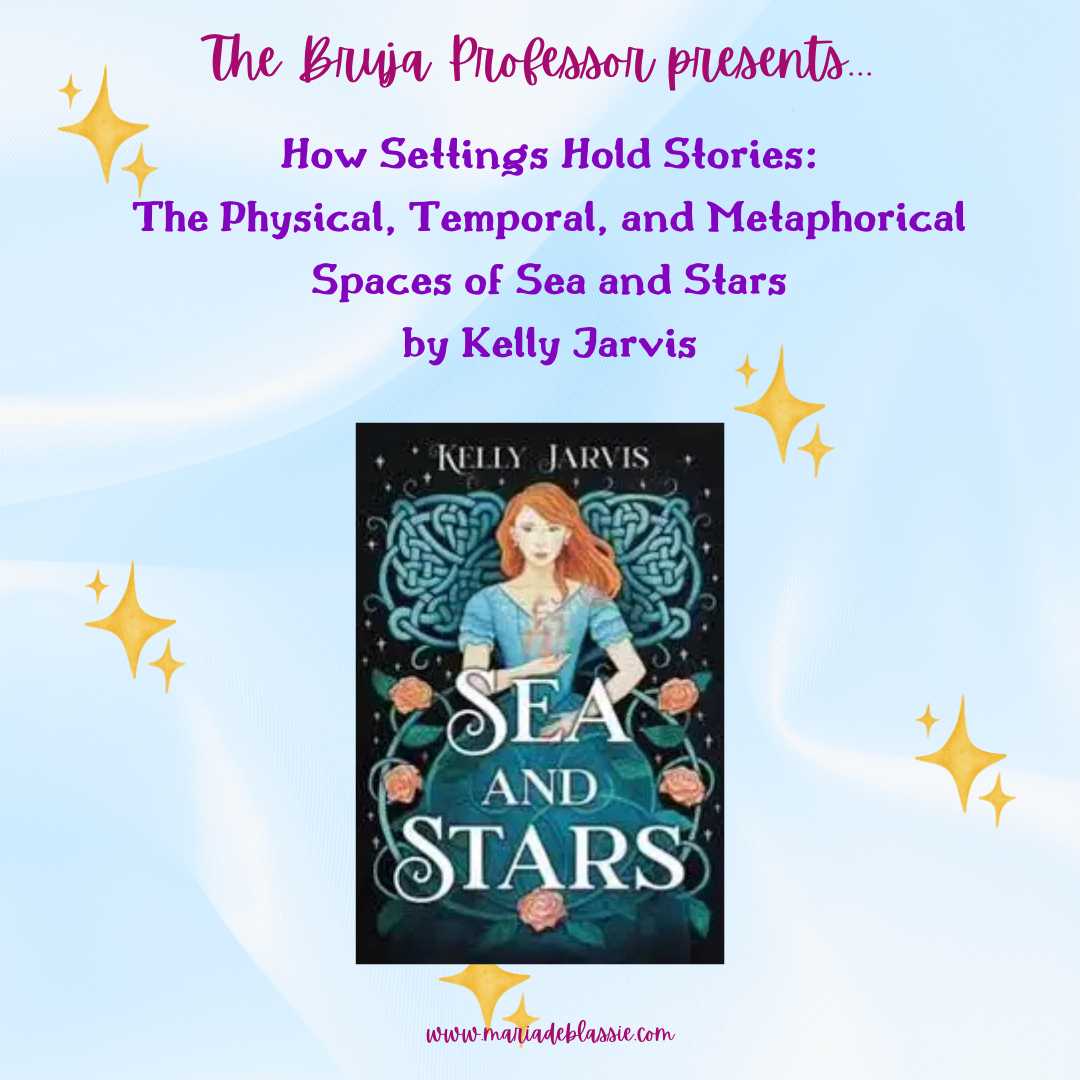
I just have to say, before I hand this post off to Kelly, that her latest book, Sea and Stars, is an absolute delight. If you love Practical Magic, enchanting folklore, and fairytales, this book is for you. The romance is equally exquisite, compelling readers to feel a fundamental truth: love is the most profound magic of all. This is a book to savor and return to again and again.
When I was in graduate school, I took a Faulkner class taught by our department’s quirkiest professor, Dr. Conway. He signed his emails ‘tis himself and periodically halted lectures to speak of the fairies who lived in the bright red leaves of our campus maple trees, but he also taught his students about the poignant intersections between literature and the real world. “Faulkner’s works are inseparable from the American South,” he once said as he stared at the New England scenery outside our classroom window. “If you want to be a writer, always remember, the land itself has stories to tell.”
Although I abandoned my study of Faulkner at the end of that semester to focus on the 18th and 19th century British domestic fiction that laid the groundwork for today’s thriving romance genre, I never forgot Dr. Conway’s advice. Many years later, when Kate Wolford, the Founder of The Fairy Tale Magazine, suggested I expand one of my character vignettes into a full romance novel, my first step, inspired by ‘tis himself, was to move the nondescript physical and temporal spaces of my tale into specific real-world settings. Then I listened as the lands of my story spoke to me, coloring my characters as surely as the New England air paints green leaves scarlet with its autumnal breath.
Midsummer Magic, the title of the vignette that was to become Sea and Stars, featured a character named Arabella Porter, the last living member of a matriarchal Scottish clan gifted with fairy magic, so it didn’t take me long to settle on the Isle of Skye as the perfect real-world setting for Arabella’s home. As I researched the island’s history, read its legends, listened to its folk music, and poured over photographs of its untamed countryside, I felt myself slip under its intoxicating spell. Soon the wind-swept moors, the blooming thistle, and the tall peaks of the Cuillin Mountains, which loom over the coastline like an orderly row of witches’ hats, cemented themselves in my mind as symbols of the Porter Clan’s natural beauty and ancient wisdom. The stone circles of Skye’s Fairy Glen, the turquoise waters of its Fairy Pools, and the tattered silk of its Fairy Flag, an enchanted keepsake still housed at Dunvegan Castle, became more than background material for my novel; they became markers on its metaphorical map, highlighting the quiet strength of the Porter women whose wild natures stand firm against patriarchal power. Even the island’s shape, which looks like a raven returning home to roost on the Scottish mainland, cast its magic over Sea and Stars, serving as a physical representation of the perilous journey that would ultimately lead Arabella back home.
Because the Isle of Skye’s landscape wrote itself upon the main female character of my romance, I wanted my book’s second setting to be synonymous with the main male character, James Alden. Since Sea and Stars is a real-world reworking of my favorite fairy tale, Beauty and the Beast, I needed a setting that would allow James to function as both a beast and a gentleman. It wasn’t until I settled on the coastal village of Mystic, Connecticut that James’ complex nature came into focus. Like the Isle of Skye, Mystic is a liminal place haunted by its past. Carved out of two neighboring towns, the village straddles the Mystic River, a tidal estuary that ebbs and flows into Fishers Island Sound. Settled by colonizers in 1634 and the site of a large-scale Pequot massacre in 1637, the village reflects America’s violent aggression against Indigenous populations, but its 19th century contributions to the maritime industry exemplify the beauty of human ingenuity. During America’s Golden Age of Sail, Mystic was a shipbuilding center that launched more than six hundred merchant and whaling vessels, and today, The Mystic Seaport Museum, a recreation of a 19th century seaside village and a working shipyard specializing in restoration, celebrates the area’s storied history. Countless years of wandering through Mystic’s physical landscape helped me envision James as a wealthy 19th century shipbuilder who had once run away from his responsibilities to hunt whales on the open ocean. In this way, James is both an educated businessman and a hardened harpooner with a violent past. Just as the steadfast Cuillin Mountains of Skye echo Arabella’s enduring sense of independence, James’ experiences aboard a whale ship in his youth mirror the painful but necessary choices he makes as he navigates the dangerous socio-political landscape of Antebellum America.
Sea and Stars is a Gothic romance, and, since the Gothic genre uses setting in deliberate ways, I wanted the settings within Skye and Mystic to work as psychological forces that would propel my characters’ actions. Each of the ten sections in my novel is defined by a particular setting, and houses, both grand and modest, old and new, are presented as sentient places born of blood and story. When James and Arabella are finally forced to confront the mysterious synchronicities of their past, the settings they occupy become less stable, eventually giving way to places not found on physical maps. Circling this progression through diminishing setting size is the title, Sea and Stars, which evokes primal landscapes so vast we cannot fully comprehend them. Like any romantic story, James and Arabella’s relationship plays out on a small scale, but the grief and love they encounter stitch them to the varied experiences of human life. While the settings within my novel specifically define James and Arabella as individuals, the settings in the title serve as symbols for the elemental strength and transformative power of true love.
Because settings are comprised of both space and time, the temporal setting of Sea and Stars, March 1847 through August 1848, tells part of my story as well. The Celtic Wheel of the Year, which marks the turning of the seasons, becomes a point of intersection for James and Arabella who are both of Celtic ancestry, and the 1840’s, a decade between the agrarian idealism of the Romantic age and the industrialization of high Victorianism, establishes a context for their interaction with political and social change. The era’s billowing sails and sweeping skirts feel inherently romantic to my mind, and the Gothic imagination, which flourished throughout the 1840’s, inspired me to haunt both my characters and my settings with shadowy recollections of the past.
I chose the specific temporal setting of 1847 as a nod to the publication year of one of my favorite Gothic romances, Jane Eyre. Published under Charlotte Brönte’s pseudonym Currer Bell, Jane Eyre follows the courtship of a lonely governess and a wealthy landowner who harbors a dangerous secret, and its plot is shaped by the same folklore and fairy tales that function as scaffolding for Sea and Stars. Jane Eyre is not the only book which works its way into the background of my novel. The romances of Jane Austen and Sir Walter Scott, the moral dilemmas of The Odyssey and Paradise Lost, and the beautiful words of John Keats and William Shakespeare weave themselves into my story as well. Even the ships James sails upon, The Shepherd and The Nymph, named for the titular characters in Christopher Marlowe’s The Passionate Shepherd to His Love and Sir Walter Ralegh’s The Nymph’s Reply to the Shepherd, connect James and Arabella’s romance to the turbulent tales of love that have come before it. Although my novel can be enjoyed by readers unfamiliar with these works, the stories I reference become metaphorical settings that James and Arabella sail through as they search for their own happily-ever-after. Like the ghosts and fairies who linger on the shores of Mystic and Skye, stories haunt the landscapes of Sea and Stars, becoming cauldrons that hold the literary past over the flames of contemporary thought in the hopes of brewing something new.
“If you want to be a writer,” my old professor Dr. Conway once told me, “always remember, the land itself has stories to tell.” In listening to these stories, I learned that the land carries magic of its own. The curl of a wave that scatters shells across the shore is as enchanting as the transformations found in Beauty and the Beast, and once I realized this, my settings became inextricably linked to the tale I wanted to tell. The fairy magic that shimmers beneath the surface of Sea and Stars is derived from the liminality of its spaces; an island off the coast of Scotland, a New England village spanning a tidal river, a century of social and political metamorphoses, and a collection of stories whose words have changed my life. Like everything I have ever written, Sea and Stars is my love letter to the magic of storytelling itself, and I am grateful to the physical, temporal, and metaphorical settings which hold my story in the hollows of their hands.
Guest Contributor Bio
Kelly Jarvis teaches at writing and literature at Central Connecticut State University, works as a Contributing Writer for The Fairy Tale Magazine, and is a recurring Columnist for Eternal Haunted Summer. Her poetry and stories have appeared in A Moon of One’s Own, Blue Heron Review, Corvid Queen, Mermaids Monthly, The Chamber Magazine, The Magic of Us, and Mothers of Enchantment: New Tales of Fairy Godmothers. Her debut novella, Selkie Moon, was a semi-finalist in the Speculative Fiction Indie Novella Championship. Sea and Stars is her first romance novel.
Connect with Kelly on Facebook (Kelly Jarvis, Author), Instagram (@kellyjarviswriter), Bluesky (@kellyjarviswriter.bsky.social) or visit her at https://kellyjarviswriter.com/
The Bruja Professor, a witchy take on literature, the occult & pop culture, is the scholarly sister to Enchantment Learning & Living, an inspirational blog celebrating life’s simple pleasures, everyday mysticism, and delectable recipes that are guaranteed to stir the kitchen witch in you.
If you enjoyed what you just read and believe that stories are magic & true magic is in the everyday…or your next good read, subscribe to my newsletter below for regular doses of enchantment.
Want even more inspiration? Follow me on Instagram and Facebook. Here’s to a magical life!