The Bruja Professor

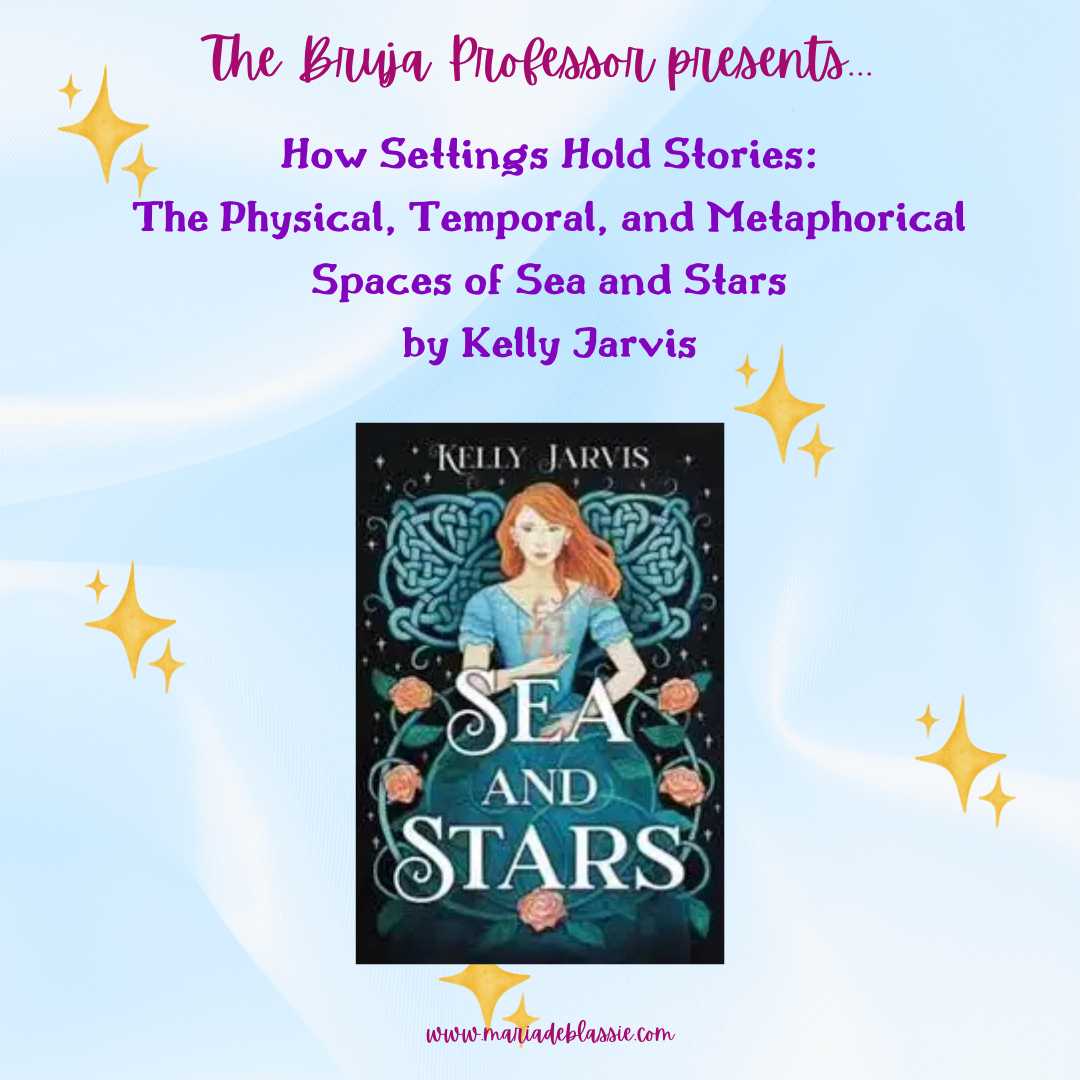
How Settings Hold Stories: The Physical, Temporal, and Metaphorical Spaces of Sea and Stars

I just have to say, before I hand this post off to Kelly, that her latest book, Sea and Stars, is an absolute delight. If you love Practical Magic, enchanting folklore, and fairytales, this book is for you. The romance is equally exquisite, compelling readers to feel a fundamental truth: love is the most profound magic of all. This is a book to savor and return to again and again.

When I was in graduate school, I took a Faulkner class taught by our department’s quirkiest professor, Dr. Conway. He signed his emails ‘tis himself and periodically halted lectures to speak of the fairies who lived in the bright red leaves of our campus maple trees, but he also taught his students about the poignant intersections between literature and the real world. “Faulkner’s works are inseparable from the American South,” he once said as he stared at the New England scenery outside our classroom window. “If you want to be a writer, always remember, the land itself has stories to tell.” 

Although I abandoned my study of Faulkner at the end of that semester to focus on the 18th and 19th century British domestic fiction that laid the groundwork for today’s thriving romance genre, I never forgot Dr. Conway’s advice. Many years later, when Kate Wolford, the Founder of The Fairy Tale Magazine, suggested I expand one of my character vignettes into a full romance novel, my first step, inspired by ‘tis himself, was to move the nondescript physical and temporal spaces of my tale into specific real-world settings. Then I listened as the lands of my story spoke to me, coloring my characters as surely as the New England air paints green leaves scarlet with its autumnal breath. 

Midsummer Magic, the title of the vignette that was to become Sea and Stars, featured a character named Arabella Porter, the last living member of a matriarchal Scottish clan gifted with fairy magic, so it didn’t take me long to settle on the Isle of Skye as the perfect real-world setting for Arabella’s home. As I researched the island’s history, read its legends, listened to its folk music, and poured over photographs of its untamed countryside, I felt myself slip under its intoxicating spell. Soon the wind-swept moors, the blooming thistle, and the tall peaks of the Cuillin Mountains, which loom over the coastline like an orderly row of witches’ hats, cemented themselves in my mind as symbols of the Porter Clan’s natural beauty and ancient wisdom. The stone circles of Skye’s Fairy Glen, the turquoise waters of its Fairy Pools, and the tattered silk of its Fairy Flag, an enchanted keepsake still housed at Dunvegan Castle, became more than background material for my novel; they became markers on its metaphorical map, highlighting the quiet strength of the Porter women whose wild natures stand firm against patriarchal power. Even the island’s shape, which looks like a raven returning home to roost on the Scottish mainland, cast its magic over Sea and Stars, serving as a physical representation of the perilous journey that would ultimately lead Arabella back home. 

Because the Isle of Skye’s landscape wrote itself upon the main female character of my romance, I wanted my book’s second setting to be synonymous with the main male character, James Alden. Since Sea and Stars is a real-world reworking of my favorite fairy tale, Beauty and the Beast, I needed a setting that would allow James to function as both a beast and a gentleman. It wasn’t until I settled on the coastal village of Mystic, Connecticut that James’ complex nature came into focus. Like the Isle of Skye, Mystic is a liminal place haunted by its past. Carved out of two neighboring towns, the village straddles the Mystic River, a tidal estuary that ebbs and flows into Fishers Island Sound. Settled by colonizers in 1634 and the site of a large-scale Pequot massacre in 1637, the village reflects America’s violent aggression against Indigenous populations, but its 19th century contributions to the maritime industry exemplify the beauty of human ingenuity. During America’s Golden Age of Sail, Mystic was a shipbuilding center that launched more than six hundred merchant and whaling vessels, and today, The Mystic Seaport Museum, a recreation of a 19th century seaside village and a working shipyard specializing in restoration, celebrates the area’s storied history. Countless years of wandering through Mystic’s physical landscape helped me envision James as a wealthy 19th century shipbuilder who had once run away from his responsibilities to hunt whales on the open ocean. In this way, James is both an educated businessman and a hardened harpooner with a violent past. Just as the steadfast Cuillin Mountains of Skye echo Arabella’s enduring sense of independence, James’ experiences aboard a whale ship in his youth mirror the painful but necessary choices he makes as he navigates the dangerous socio-political landscape of Antebellum America. 

Sea and Stars is a Gothic romance, and, since the Gothic genre uses setting in deliberate ways, I wanted the settings within Skye and Mystic to work as psychological forces that would propel my characters’ actions. Each of the ten sections in my novel is defined by a particular setting, and houses, both grand and modest, old and new, are presented as sentient places born of blood and story. When James and Arabella are finally forced to confront the mysterious synchronicities of their past, the settings they occupy become less stable, eventually giving way to places not found on physical maps. Circling this progression through diminishing setting size is the title, Sea and Stars, which evokes primal landscapes so vast we cannot fully comprehend them. Like any romantic story, James and Arabella’s relationship plays out on a small scale, but the grief and love they encounter stitch them to the varied experiences of human life. While the settings within my novel specifically define James and Arabella as individuals, the settings in the title serve as symbols for the elemental strength and transformative power of true love. 

Because settings are comprised of both space and time, the temporal setting of Sea and Stars, March 1847 through August 1848, tells part of my story as well. The Celtic Wheel of the Year, which marks the turning of the seasons, becomes a point of intersection for James and Arabella who are both of Celtic ancestry, and the 1840’s, a decade between the agrarian idealism of the Romantic age and the industrialization of high Victorianism, establishes a context for their interaction with political and social change. The era’s billowing sails and sweeping skirts feel inherently romantic to my mind, and the Gothic imagination, which flourished throughout the 1840’s, inspired me to haunt both my characters and my settings with shadowy recollections of the past. 

I chose the specific temporal setting of 1847 as a nod to the publication year of one of my favorite Gothic romances, Jane Eyre. Published under Charlotte Brönte’s pseudonym Currer Bell, Jane Eyre follows the courtship of a lonely governess and a wealthy landowner who harbors a dangerous secret, and its plot is shaped by the same folklore and fairy tales that function as scaffolding for Sea and Stars. Jane Eyre is not the only book which works its way into the background of my novel. The romances of Jane Austen and Sir Walter Scott, the moral dilemmas of The Odyssey and Paradise Lost, and the beautiful words of John Keats and William Shakespeare weave themselves into my story as well. Even the ships James sails upon, The Shepherd and The Nymph, named for the titular characters in Christopher Marlowe’s The Passionate Shepherd to His Love and Sir Walter Ralegh’s The Nymph’s Reply to the Shepherd, connect James and Arabella’s romance to the turbulent tales of love that have come before it. Although my novel can be enjoyed by readers unfamiliar with these works, the stories I reference become metaphorical settings that James and Arabella sail through as they search for their own happily-ever-after. Like the ghosts and fairies who linger on the shores of Mystic and Skye, stories haunt the landscapes of Sea and Stars, becoming cauldrons that hold the literary past over the flames of contemporary thought in the hopes of brewing something new.

“If you want to be a writer,” my old professor Dr. Conway once told me, “always remember, the land itself has stories to tell.” In listening to these stories, I learned that the land carries magic of its own. The curl of a wave that scatters shells across the shore is as enchanting as the transformations found in Beauty and the Beast, and once I realized this, my settings became inextricably linked to the tale I wanted to tell. The fairy magic that shimmers beneath the surface of Sea and Stars is derived from the liminality of its spaces; an island off the coast of Scotland, a New England village spanning a tidal river, a century of social and political metamorphoses, and a collection of stories whose words have changed my life. Like everything I have ever written, Sea and Stars is my love letter to the magic of storytelling itself, and I am grateful to the physical, temporal, and metaphorical settings which hold my story in the hollows of their hands.

Guest Contributor Bio

Kelly Jarvis teaches at writing and literature at Central Connecticut State University, works as a Contributing Writer for The Fairy Tale Magazine, and is a recurring Columnist for Eternal Haunted Summer. Her poetry and stories have appeared in A Moon of One’s Own, Blue Heron Review, Corvid Queen, Mermaids Monthly, The Chamber Magazine, The Magic of Us, and Mothers of Enchantment: New Tales of Fairy Godmothers. Her debut novella, Selkie Moon, was a semi-finalist in the Speculative Fiction Indie Novella Championship. Sea and Stars is her first romance novel.

Connect with Kelly on Facebook (Kelly Jarvis, Author), Instagram (@kellyjarviswriter), Bluesky (@kellyjarviswriter.bsky.social) or visit her at https://kellyjarviswriter.com/
The Bruja Professor, a witchy take on literature, the occult & pop culture, is the scholarly sister to Enchantment Learning & Living, an inspirational blog celebrating life’s simple pleasures, everyday mysticism, and delectable recipes that are guaranteed to stir the kitchen witch in you.

If you enjoyed what you just read and believe that stories are magic & true magic is in the everyday…or your next good read, subscribe to my newsletter below for regular doses of enchantment.

Want even more inspiration? Follow me on Instagram and Facebook. Here’s to a magical life!

Eldritch Gothic with C.M. Rosens...Bonus writing prompts included!

CWs for discussions of darker Gothic tropes, including cults, sibling incest, and mentions of body horror, medical/surgical horror. 

I was invited to write a blog post about the Eldritch and the Gothic, which is such a big topic that I struggled to narrow it down! So here’s a brief outline of what I think of when we use these terms, and how I choose to play with this in my own writing.

‘Eldritch’ means weird, sinister, ghostly. The old Sussex dialect term ‘ellynge’ to mean ‘eerie’ might also be cognate, which is from the Old English word el-lende, ele-lænde; adj., for ‘foreign’ or ‘strange’ (Bosworth-Toller Old English Dictionary), and can also be used to mean ‘uncanny, lonely, solitary’. Some think the word is linked to ‘elf’, and reflects the fear of Otherworldly spirits, evoking images of spectral mists, the lure of inexplicable music in the night, and the dire warnings of certain death to those who harm or insult these uncanny creatures.

It certainly has come to Otherworld connotations, and in a cosmic horror context has come to be associated with ‘Eldritch Gods’, beings beyond human imagination and understanding. Such beings are typically insectoid, or appear to come from the Deep Sea, or sometimes both. They generally relate in some way to H. P. Lovecraft’s mythos, and the concept of an Eldritch Abomination is now understood in the following way (at least, according to TV Tropes):

The Eldritch Abomination is a type of creature defined by its disregard for the natural laws of the universe as we understand them. They are grotesque mockeries of reality beyond comprehension whose disturbing otherness cannot be encompassed in any mortal tongue. ... Reality itself warps around them.

It is fairly obvious why Weird fiction – a subgenre that has almost as much debate around its scope and development as Gothic fiction does – overlaps with the Gothic and often uses the same kinds of tropes and themes. Weird fiction was, naturally, an offshoot of Gothic fiction to begin with, in much the same way that the wide umbrella of ‘Horror’ owes its many lives to the Horror Gothic and Terror Gothic novels.

Something ‘eldritch’ is meant to inspire fear, while the Gothic doesn’t always have to do that. Something can be Gothic but its effect could be horror (in the sense of deep disgust, discomfort, and shock) rather than fear or terror – something does not have to be frightening in order to horrify you. The Gothic can be a vibe, an aesthetic, and carry a sense of familiarity – the Addams Family are undoubtedly a Gothic franchise, but they play with both bathos (where the tone lapses from the sublime and highbrow to the trivial or ridiculous, often with comedic effect) and pathos (evoking pity or sadness). The Gothic can be hilarious to make a point – dark humour can be deployed to throw the horrific things into stark contrast, let the reader catch their breath at a crucial moment, or to force the reader into complicity with the horror by making laugh.

So what happens when you blend the eldritch with the Gothic as vehicles for themes and tropes that have been done to death?

Some of the things I like to play with (hopefully you will come up with more)…

1. The Eldritch Abomination as a metaphor (in my case, metaphors for class struggles, and the monstrous beings people can become when they engage in particular modes of behaviour and ideologies relating to class and status). I like to play with ‘the eldritch horror among us’ (like Lovecraft’s THE SHADOW OVER INNSMOUTH or THE DUNWICH HORROR), but have them blending with the mundane. The site of horror is not necessarily the weirdness of the monstrosity, it’s the toxic cycles of abuse they perpetuate, with their upwardly-mobile middle-class aspirations at the root of that behaviour. 

2. Real or Not? I enjoy playing with tropes where the protagonist questions their reality. In THE CROWS, the only person who was genuinely haunted by the (completely unanswered) question of ‘is this supernatural or not?’ was the Gothic Horror Monster figure, who can’t figure out if his taxidermy creation is alive in its own way, or if that’s a figment of his imagination, a hangover from his childhood where he was an abused and neglected creative child. This is a question that haunts him through the novel and acts as a reminder that even as he experiences a lot of destabilisation of his world and worldview, his world was never stable to begin with. 

3. The Gothic Horror Monster/Antihero. In my novels, the soothsayer figure is also an Eldritch Horror who regurgitates tendrils like carnivorous air-roots from a mouth at the back of his skull, the lips of which look like scar tissue. In his human form, he can see the future and conducts blood sacrifice and entrail-readings in the manner of an Etruscan or Ancient Roman haruspex, is self-taught and fluent in Old English, and does bone readings. He doesn’t think twice about human sacrifice, and believes he is destined to ascend to Eldritch Godhood. He’s also 5’5” in his human form, is chronically lonely with disordered eating issues, has depression and social anxiety, dresses in a tracksuit and grey hoodie complete with arcane tattoo sleeves and gold signet rings, is on the aromantic and asexual spectrums and so has no interest in either being the love interest or being a sexual aggressor, and is undersocialised to the point that he struggles to appropriately gauge boundaries and express his emotions. I also set him against the very human toxic abusive ex-boyfriend, who is more of an active threat to the main character than he is. 

There are so many other tropes I like to play with too - THE CROWS has Gothic tropes as chapter titles - and in making the eldritch (in the sense of Eldritch Horror/Cosmic Horror, or as eerie, strange, uncanny) the focus of a Gothic tale, rather than an element within it, you can do a lot more fun things with staples of the genre! Particularly as what’s now considered ‘uncanny’ or ‘strange’ is different from the Gothic novels of the past, and it is possible for different people from all kinds of underrepresented backgrounds/identities to take control of these elements and make them their own. 

Writing Prompts

If you’ve been inspired to try writing something with a Gothic aesthetic and eldritch elements, here are some ideas! You could brainstorm the tropes you get to see how they might be updated for a modern setting and readership, but also how they can be problematic and ways to avoid this or subvert this. 

You can spin the wheel linked here to see what you get (simply click on the image to get started). If you want to pair up your elements (X + Y) you can uncheck the box next to the one you landed on first (DON’T click the red cross, that deletes it!) and spin again to get a different result. If you find any options unchecked for your first go, make sure you add them all back in!

Liminal Spaces: if you land on this, remember that liminal spaces are spaces of transition from one state of being to another or from one place to another, they are not inherently weird or eerie. Your task here is to think about how to make it so. For example, something as simple as an open window could be classed as a liminal space, with the windowsill becoming both inside and outside. Cats often occupy liminal spaces like this! If you’re thinking in terms of the Gothic, however, a liminal space might be a crossroads or a graveyard. Who or what occupies such a space and why are they there? What happens when they travel through it, or get stuck? Is this physical or metaphorical, or both? How might this work as an eldritch (strange, eerie, uncanny) element? How might it work as a Gothic setting or aesthetic? 

Uncanny Valley: if you land on this, you might immediately think ‘What has SciFi got to do with the Gothic or Eldritch?’ If you’re unfamiliar with the term, the ‘uncanny valley’ is the hypothesised relationship between an image of a person and how closely it resembles a human being WHEN IT IS KNOWN NOT TO BE, and the strength of the [negative] emotional reaction to it. Where the line on the hypothetical graph dips further down to the “more revulsion” axis before it starts to rise again, all images that inspire those levels of revulsion dwell in the ‘uncanny valley’. In this case, I’m using this label as a shorthand for a situation where the human protagonist is faced with something they know isn’t human, but very closely resembles one, and the emotional reaction is visceral and negative. It doesn’t have to be robotic or computer-related here, you can bend and reshape it however you like, but try to figure out how to make it Gothic! (Sci-Fi can be Gothic too, of course - look at Alien as the obvious example!)

Human-Passing: Unlike ‘uncanny valley’, this is where a character is believed to be human but they are not. Or - not quite. Perhaps there’s something very subtle about them, perhaps they have a second form, perhaps they turn out to be something very different and Other, or perhaps they never really existed at all. But when the protagonist and/or the reader meets them, they pass as human, and the journey of discovering they are not is the one the reader is set on. 

The Unexplained: This is an element in the story which might never be explained to the reader, because it’s never explained to the protagonist. Something that defies explanation, that is never resolved, that leaves the reader with a sense of being haunted by the mystery after they have finished the tale itself. Perhaps a creeping, eerie feeling that the tale itself is eldritch. 

Mysterious Cult: A staple of the German tradition of Gothic fiction, featured in the Shudder novels (Schauerroman) of the late eighteenth century, cults are also a staple of Weird Fiction, a spin-off of the Gothic but also its own, equally hard to define, genre. Whether the cult was something from the past worshipping beings that came from … Elsewhere, (could be aliens, could be elves, who knows), or whether it’s more of an intimate family affair, the Mysterious Cult can solidify the protagonist’s position as an outsider. Films like Society (1989) play with a lot of Gothic tropes but not the aesthetic, setting it in Affluent American Suburbia and turn it into a metaphor for capitalism and corruption in the (very white) inward-looking, inward-loving, homogenous suburban elite. There’s a lot you can do with this. 

Tainted Bloodline: This is the most obviously problematic storyline, and it was used in the nineteenth and early twentieth centuries to explore anxieties around hereditary mental health conditions and racial ideologies. H. P. Lovecraft was particularly prone to this one, with two of the most obvious examples being The Shadow Over Innsmouth and The Dunwich Horror. Edgar Allan Poe explored these themes too, particularly in The Fall of the House of Usher. It’s a coded reason behind the madness of Bertha Mason in Charlotte Bronte’s Jane Eyre, since she’s from Jamaica and colonial British and European families who had been there since the 1600s were suspected of having ‘tainted’ blood through their ‘relations’ with their slaves. Heathcliff’s origins are mysterious but he is explicitly a Romani child, and the novel implies that this is the reason for his early wildness as a child and then aggressive and abusive behaviour as an adult in Emily Bronte’s Wuthering Heights: he never ‘belongs’ to society, and becomes monstrous when set against it. 

Moving away from this to anxieties around ‘changing DNA’ or forced experiments and/or procedures which can create mutated or monstrous offspring, extreme body horror novels, like Geek Love by Katherine Dunn, play with this in terms of genetic mutations, sometimes caused by radiation poisoning (sometimes on purpose, in grotesque experiments), and focus on more modern anxieties around nuclear technology, nuclear warfare, medical experimentation, and cosmetic surgery or other kinds of surgical horror. Arguably, Arthur Machen’s classic, The Great God Pan, falls under this kind of category, as the female antagonist is the result of a doctor’s cruel experiments upon his wife’s brain. 

Other kinds of tales that fall under this are stories that deal with this involve (often tragic) histories of sibling incest (so many of these, but the Irish film The Lodgers (2017) is one example, as is Crimson Peak (2015)), bestiality or offspring of a monster (La Bête, a 1975 French erotic horror film written, edited, and directed by Walerian Borowczyk, banned in most countries after its release). With this one, you might want to not use it but consider if it is possible to move away from these problematic usages, and dig into how it can be used to express other anxieties, or if you do use it in a fiction prompt, think how it can be subverted to reimagine other, potentially better ways of being.

Tentacles: A tongue-in-cheek one to end on, but take this to mean a symbol of something that does not belong in our reality, that warps reality to shape itself, that may have recognisable components but is not a whole that can be easily described or comprehended. It doesn’t have to be a cosmic horror scale story. Tentacles can show up in unexpected and mundane places, warping our perception of that place and turning everything we thought we knew upside down. See what you can come up with. 
Guest Contributor Bio

C.M. Rosens (she/her) is a dark fiction author with an academic alter-ego, podcaster, and blogger. if you’d like to know more about her work, you can find her links (including Newsletter, Website and Podcast) here: cmrosens.carrd.co.  

The Bruja Professor, a witchy take on literature, the occult & pop culture, is the scholarly sister to Enchantment Learning & Living, an inspirational blog celebrating life’s simple pleasures, everyday mysticism, and delectable recipes that are guaranteed to stir the kitchen witch in you.

If you enjoyed what you just read and believe that stories are magic & true magic is in the everyday…or your next good read, subscribe to my newsletter below for regular doses of enchantment.

Want even more inspiration? Follow me on Instagram, Facebook, Pinterest, and Twitter. Here’s to a magical life!