The Bruja Professor

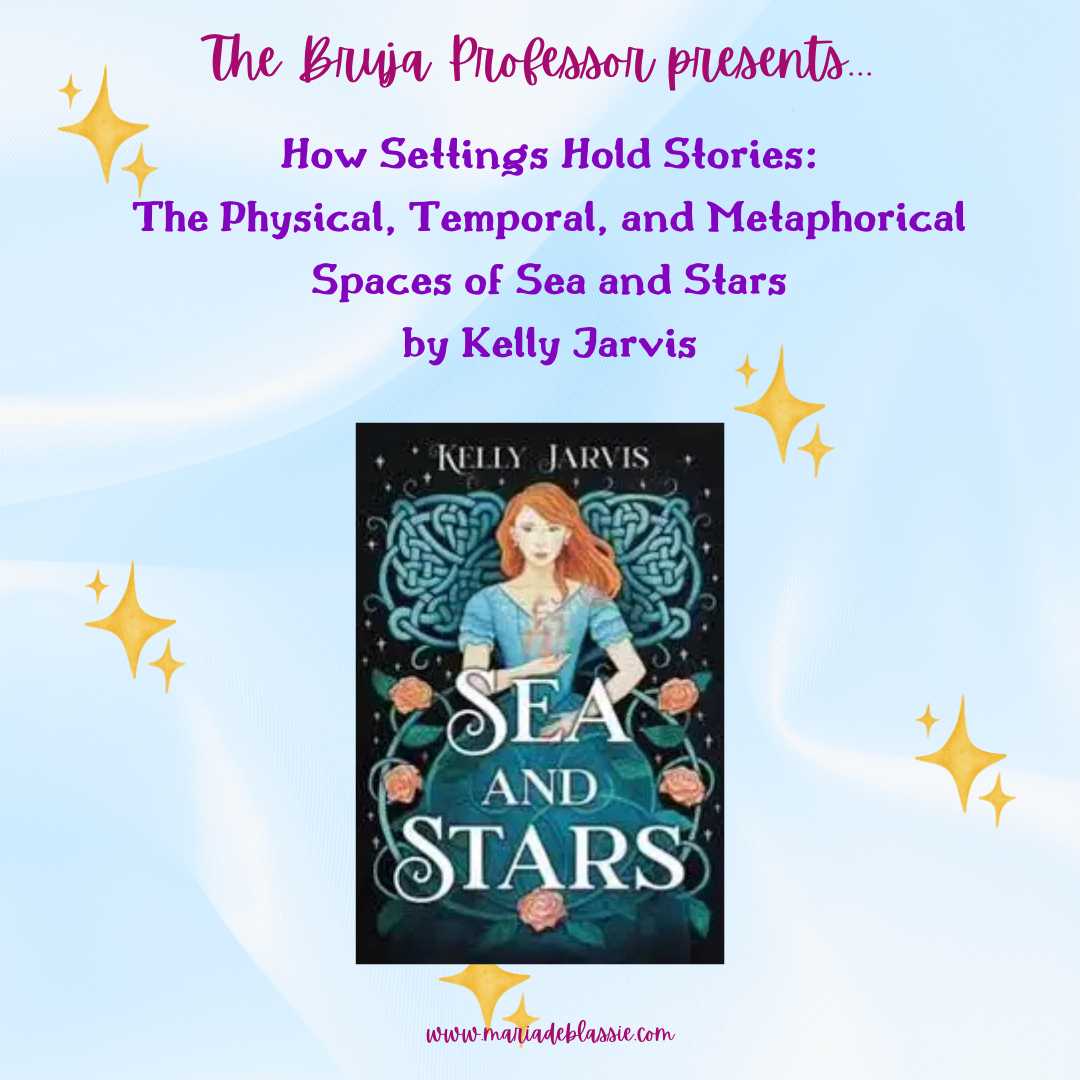
How Settings Hold Stories: The Physical, Temporal, and Metaphorical Spaces of Sea and Stars

I just have to say, before I hand this post off to Kelly, that her latest book, Sea and Stars, is an absolute delight. If you love Practical Magic, enchanting folklore, and fairytales, this book is for you. The romance is equally exquisite, compelling readers to feel a fundamental truth: love is the most profound magic of all. This is a book to savor and return to again and again.

When I was in graduate school, I took a Faulkner class taught by our department’s quirkiest professor, Dr. Conway. He signed his emails ‘tis himself and periodically halted lectures to speak of the fairies who lived in the bright red leaves of our campus maple trees, but he also taught his students about the poignant intersections between literature and the real world. “Faulkner’s works are inseparable from the American South,” he once said as he stared at the New England scenery outside our classroom window. “If you want to be a writer, always remember, the land itself has stories to tell.” 

Although I abandoned my study of Faulkner at the end of that semester to focus on the 18th and 19th century British domestic fiction that laid the groundwork for today’s thriving romance genre, I never forgot Dr. Conway’s advice. Many years later, when Kate Wolford, the Founder of The Fairy Tale Magazine, suggested I expand one of my character vignettes into a full romance novel, my first step, inspired by ‘tis himself, was to move the nondescript physical and temporal spaces of my tale into specific real-world settings. Then I listened as the lands of my story spoke to me, coloring my characters as surely as the New England air paints green leaves scarlet with its autumnal breath. 

Midsummer Magic, the title of the vignette that was to become Sea and Stars, featured a character named Arabella Porter, the last living member of a matriarchal Scottish clan gifted with fairy magic, so it didn’t take me long to settle on the Isle of Skye as the perfect real-world setting for Arabella’s home. As I researched the island’s history, read its legends, listened to its folk music, and poured over photographs of its untamed countryside, I felt myself slip under its intoxicating spell. Soon the wind-swept moors, the blooming thistle, and the tall peaks of the Cuillin Mountains, which loom over the coastline like an orderly row of witches’ hats, cemented themselves in my mind as symbols of the Porter Clan’s natural beauty and ancient wisdom. The stone circles of Skye’s Fairy Glen, the turquoise waters of its Fairy Pools, and the tattered silk of its Fairy Flag, an enchanted keepsake still housed at Dunvegan Castle, became more than background material for my novel; they became markers on its metaphorical map, highlighting the quiet strength of the Porter women whose wild natures stand firm against patriarchal power. Even the island’s shape, which looks like a raven returning home to roost on the Scottish mainland, cast its magic over Sea and Stars, serving as a physical representation of the perilous journey that would ultimately lead Arabella back home. 

Because the Isle of Skye’s landscape wrote itself upon the main female character of my romance, I wanted my book’s second setting to be synonymous with the main male character, James Alden. Since Sea and Stars is a real-world reworking of my favorite fairy tale, Beauty and the Beast, I needed a setting that would allow James to function as both a beast and a gentleman. It wasn’t until I settled on the coastal village of Mystic, Connecticut that James’ complex nature came into focus. Like the Isle of Skye, Mystic is a liminal place haunted by its past. Carved out of two neighboring towns, the village straddles the Mystic River, a tidal estuary that ebbs and flows into Fishers Island Sound. Settled by colonizers in 1634 and the site of a large-scale Pequot massacre in 1637, the village reflects America’s violent aggression against Indigenous populations, but its 19th century contributions to the maritime industry exemplify the beauty of human ingenuity. During America’s Golden Age of Sail, Mystic was a shipbuilding center that launched more than six hundred merchant and whaling vessels, and today, The Mystic Seaport Museum, a recreation of a 19th century seaside village and a working shipyard specializing in restoration, celebrates the area’s storied history. Countless years of wandering through Mystic’s physical landscape helped me envision James as a wealthy 19th century shipbuilder who had once run away from his responsibilities to hunt whales on the open ocean. In this way, James is both an educated businessman and a hardened harpooner with a violent past. Just as the steadfast Cuillin Mountains of Skye echo Arabella’s enduring sense of independence, James’ experiences aboard a whale ship in his youth mirror the painful but necessary choices he makes as he navigates the dangerous socio-political landscape of Antebellum America. 

Sea and Stars is a Gothic romance, and, since the Gothic genre uses setting in deliberate ways, I wanted the settings within Skye and Mystic to work as psychological forces that would propel my characters’ actions. Each of the ten sections in my novel is defined by a particular setting, and houses, both grand and modest, old and new, are presented as sentient places born of blood and story. When James and Arabella are finally forced to confront the mysterious synchronicities of their past, the settings they occupy become less stable, eventually giving way to places not found on physical maps. Circling this progression through diminishing setting size is the title, Sea and Stars, which evokes primal landscapes so vast we cannot fully comprehend them. Like any romantic story, James and Arabella’s relationship plays out on a small scale, but the grief and love they encounter stitch them to the varied experiences of human life. While the settings within my novel specifically define James and Arabella as individuals, the settings in the title serve as symbols for the elemental strength and transformative power of true love. 

Because settings are comprised of both space and time, the temporal setting of Sea and Stars, March 1847 through August 1848, tells part of my story as well. The Celtic Wheel of the Year, which marks the turning of the seasons, becomes a point of intersection for James and Arabella who are both of Celtic ancestry, and the 1840’s, a decade between the agrarian idealism of the Romantic age and the industrialization of high Victorianism, establishes a context for their interaction with political and social change. The era’s billowing sails and sweeping skirts feel inherently romantic to my mind, and the Gothic imagination, which flourished throughout the 1840’s, inspired me to haunt both my characters and my settings with shadowy recollections of the past. 

I chose the specific temporal setting of 1847 as a nod to the publication year of one of my favorite Gothic romances, Jane Eyre. Published under Charlotte Brönte’s pseudonym Currer Bell, Jane Eyre follows the courtship of a lonely governess and a wealthy landowner who harbors a dangerous secret, and its plot is shaped by the same folklore and fairy tales that function as scaffolding for Sea and Stars. Jane Eyre is not the only book which works its way into the background of my novel. The romances of Jane Austen and Sir Walter Scott, the moral dilemmas of The Odyssey and Paradise Lost, and the beautiful words of John Keats and William Shakespeare weave themselves into my story as well. Even the ships James sails upon, The Shepherd and The Nymph, named for the titular characters in Christopher Marlowe’s The Passionate Shepherd to His Love and Sir Walter Ralegh’s The Nymph’s Reply to the Shepherd, connect James and Arabella’s romance to the turbulent tales of love that have come before it. Although my novel can be enjoyed by readers unfamiliar with these works, the stories I reference become metaphorical settings that James and Arabella sail through as they search for their own happily-ever-after. Like the ghosts and fairies who linger on the shores of Mystic and Skye, stories haunt the landscapes of Sea and Stars, becoming cauldrons that hold the literary past over the flames of contemporary thought in the hopes of brewing something new.

“If you want to be a writer,” my old professor Dr. Conway once told me, “always remember, the land itself has stories to tell.” In listening to these stories, I learned that the land carries magic of its own. The curl of a wave that scatters shells across the shore is as enchanting as the transformations found in Beauty and the Beast, and once I realized this, my settings became inextricably linked to the tale I wanted to tell. The fairy magic that shimmers beneath the surface of Sea and Stars is derived from the liminality of its spaces; an island off the coast of Scotland, a New England village spanning a tidal river, a century of social and political metamorphoses, and a collection of stories whose words have changed my life. Like everything I have ever written, Sea and Stars is my love letter to the magic of storytelling itself, and I am grateful to the physical, temporal, and metaphorical settings which hold my story in the hollows of their hands.

Guest Contributor Bio

Kelly Jarvis teaches at writing and literature at Central Connecticut State University, works as a Contributing Writer for The Fairy Tale Magazine, and is a recurring Columnist for Eternal Haunted Summer. Her poetry and stories have appeared in A Moon of One’s Own, Blue Heron Review, Corvid Queen, Mermaids Monthly, The Chamber Magazine, The Magic of Us, and Mothers of Enchantment: New Tales of Fairy Godmothers. Her debut novella, Selkie Moon, was a semi-finalist in the Speculative Fiction Indie Novella Championship. Sea and Stars is her first romance novel.

Connect with Kelly on Facebook (Kelly Jarvis, Author), Instagram (@kellyjarviswriter), Bluesky (@kellyjarviswriter.bsky.social) or visit her at https://kellyjarviswriter.com/
The Bruja Professor, a witchy take on literature, the occult & pop culture, is the scholarly sister to Enchantment Learning & Living, an inspirational blog celebrating life’s simple pleasures, everyday mysticism, and delectable recipes that are guaranteed to stir the kitchen witch in you.

If you enjoyed what you just read and believe that stories are magic & true magic is in the everyday…or your next good read, subscribe to my newsletter below for regular doses of enchantment.

Want even more inspiration? Follow me on Instagram and Facebook. Here’s to a magical life!
Made in Italy: The Spells and Secrets of Streghe with Alessandra Pino

This is a fantastic exploration of Italian witches in folklore and personal history by Alessandra Pino, who also wrote a fantastic article for The Bruja Professor on The Food of Witchcraft in Ira Levin’s Rosemary’s Baby.

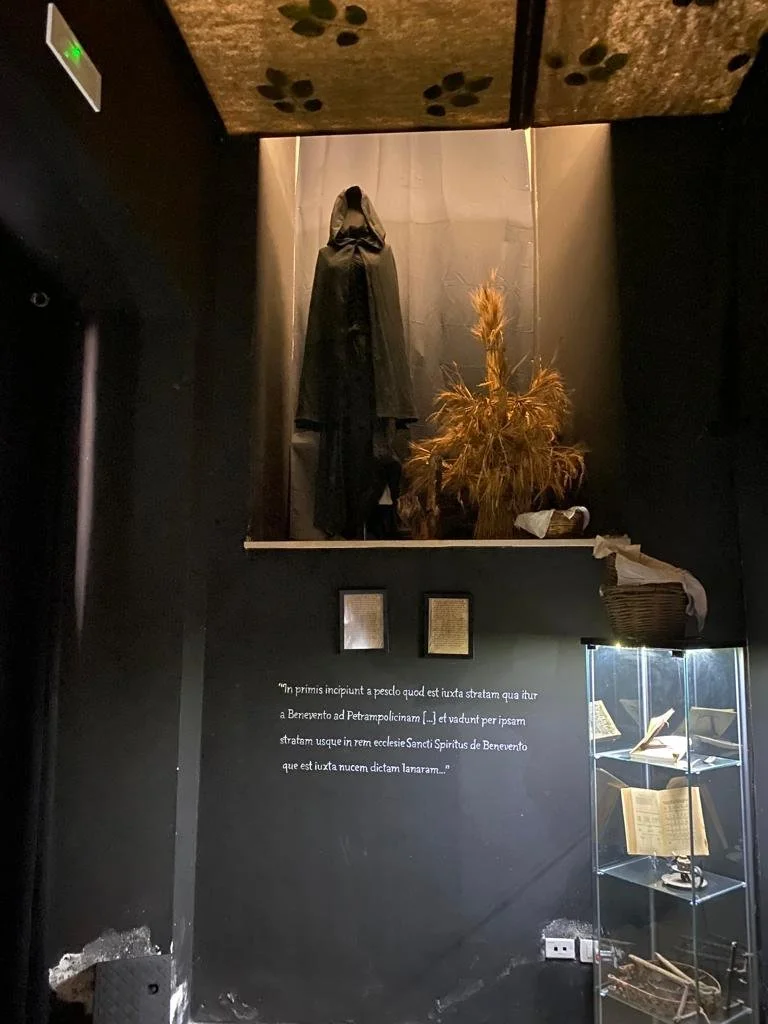
Witches cloak at the Museo Streghe in Benevento, Italy.

Maria ‘a Longa

"Don’t you dare go down that road,"
The old woman warns, eyes aglow,
"For Maria ‘a Longa waits below,
Her fingers long as shadows grow."

She lived in a well, or so they say,
Silent, watching, waiting prey—
Rise she would, from darkened deep,
To pull the careless into sleep.

Once a woman, thin and tall,
Draped in black—a ghostly shawl.
Her husband woke to whispered words,
A spell, a flight, a world unheard.

With broomstick high, she soared, she flew,
Through midnight’s arch of starless blue.
Till tricked by lard, she leapt in vain—
A plunge, a scream, a death-stained rain.

And now she waits, her fingers cold,
To drag the living to the old—
The drowning place, the silent deep,
Where breath is lost, and souls must sleep.

I am half Italian, from a town called Nocera Inferiore, about thirty minutes by train from Naples and ten from Pompeii, where cobbled streets open into sunlit piazzas and quiet courtyards, but just as often narrow into winding alleys that squeeze the pavement into a mere sliver of shaded space.

"Don’t you dare go down there," my best friend’s grandmother warned, her finger trembling toward the darkened alley.

My friend would sigh, unimpressed, brushing off the old tales.
But me? I leaned in closer, always hungry for more.

"Why not, Signora?"

"Because Maria ‘a Longa is down there," she’d reply, lowering her voice. "A woman dressed in black, with long, long hands that reach up and snatch anyone who lingers too close to where the road gets darker."

The original story, she told us, was that Maria ‘a Longa had once lived in a well. The moment she saw someone near, she would rise from the water—faster than you could blink—grabbing them with her long, dark fingers and dragging them down into the depths, drowning them forever.

These stories were as much a part of my childhood as her cooking, and Maria ‘a Longa was one of the most terrifying. According to her, Maria ‘a Longa had once been the wife of Giovanni, a farmer from the Benevento countryside. She was tall and thin, always dressed in black, and rarely spoke. One night, Giovanni was jolted awake by a strange noise. What he saw made his blood run cold—his wife, standing by the window, was rubbing a mysterious ointment onto her body. Without hesitation, she climbed onto the windowsill, mounted a broomstick, and leapt into the night, soaring into the sky.

The next morning, deeply disturbed, Giovanni rushed to his mother in the village.

"Mamma, what have I married? I saw her with my own eyes—flying on a broomstick!"

His mother gasped. "Giovà, that’s no Befana you’ve got at home—that’s a strega! You need to be very careful!"

Following his mother’s advice, Giovanni replaced his wife’s enchanted ointment with lard, which looked exactly the same. Nothing happened for days, but when Saturday night came, she followed her usual ritual—rubbing the ointment on her body, mounting the broom, and murmuring strange words before launching herself from the window.

This time, she didn’t fly.

A scream rang out, followed by a heavy thud and a loud splash. Maria ‘a Longa had plummeted straight down, hitting her head on the edge of the well beneath the window and falling in. She drowned, and from that night on, her restless spirit haunted every well, waiting to pull down the unwary—especially children.

Maria ‘a Longa wasn’t the only witch La Signora warned me about. Benevento had others—the Zucculara and the Janara.

The Zucculara was a limping witch who haunted the Triggio, the old Roman theatre district. She chased after solitary passersby, her wooden clogs clattering against the cobblestones. No one had ever seen her face—no one had dared to turn around.

The Janara, though, was the most feared. She was said to be a woman born at midnight on Christmas Eve, but due to a mistake by the priest at her baptism, she never properly received the sacrament of confirmation, and so she became a Janara. Some say her name comes from ‘Dianara,’ linked to the priestesses of Diana, the ancient goddess of the moon, forests, and childbirth. Others claim it comes from ‘ianua,’ meaning door, because the Janara slipped under doors in the form of a whispering wind.

La Signora told me you could protect your home from a Janara by placing a broom upside down behind the door or scattering salt. Janare suffered from an uncontrollable urge to count things, and before entering, they’d be forced to count every bristle of the broom or every grain of salt—taking them all night, until dawn drove them away.

If you ever suspected a Janara’s presence, you had to say, "Janara, today is Saturday," reminding her it was time to fly to the legendary walnut tree of Benevento, where witches gathered every Sabbath. Another trick was to grip her hair. If she asked, "What do you have in your hand?" you had to answer, "Iron and steel." If you said "hair," she’d slip away, cackling, "I’ll slither away like an eel!"

Janare also had a nasty habit of tormenting sleepers, sitting on their chests and causing nightmares—a shadowy presence pressing down, leaving victims gasping for breath. They stole horses from their stables, riding them to exhaustion and weaving mischievous braids into their manes. And if a baby woke up twisted in their crib, people would whisper that a Janara had passed them through the keyhole in the night.

La Signora’s stories were meant to scare me into obedience—don’t go down dark alleyways, stay away from wells, don’t open doors at night, don’t mess with things you don’t understand. But they also made the town feel alive with shadows and whispers, with the past reaching into the present. And, honestly, even now, I’d think twice before walking down a dark alleyway.

Unlike my own grandmother, whose Catholicism was deeply devout but devoid of superstition, my friend’s grandmother fully embraced these beliefs. She would recount stories of malocchio with unwavering conviction, and she possessed a natural ability to interpret dreams according to la Smorfia. Her house was adorned with protective charms—horseshoes above doors, garlic wreaths in the kitchen, and, of course, a corno tucked discreetly in her purse. Through her, I came to understand how deeply these superstitions were woven into everyday life, serving as both a source of caution and a means of comfort.

The Janara’s Curse

She slips beneath the door at night,
A whisper, thin, a stolen sight.
She presses down upon your chest,
A weight of air, a dream’s unrest.

She braids the mane of weary steed,
She makes the sleeper toss and plead.
She rides the wind, she laughs, she sings,
And turns the night to haunted things.

But lay a broomstick by the door,
Or scatter salt upon the floor.
For she must count—each bristle, grain,
Till morning breaks the curse again.

And if you catch her by the hair,
Hold fast, speak true, do not despair.
Say "Iron and steel!"—her fate is sealed,
Say "Hair," and she is free to yield.

Neapolitan Superstitions: An Origin Story

The rich and evocative superstitions of Naples have deep roots in the hardships and misfortunes that afflicted the city, particularly in the 19th century. But what exactly is superstition? According to the Roman orator Cicero, the superstitious were those who, through prayers, offerings, and sacrifices, sought divine intervention for salvation. More specifically, superstition can be understood as an irrational belief that objects or behaviours can influence future events.

One of the most enduring and feared superstitions in Naples is the malocchio (evil eye), the belief that a person can cause harm—whether intentionally or not—through a malevolent gaze that transmits negative energy. It is thought that this tradition took hold in Naples around the 18th century, giving rise to protective amulets such as the horseshoe, the gobbetto (hunchback charm), the garlic wreath, and most notably, the corno (horn). The corno remains the most widespread protective talisman in Neapolitan homes. According to ancient tradition, for it to be effective, it must be handmade, hard, hollow, curved, and pointed.

Superstition also intertwines with la Smorfia, the mystical tradition of interpreting dreams and translating them into numbers for the lottery. Every extraordinary event or dream is assigned a numerical value, which believers use to seek fortune.

The Role of King Ferdinand IV and the Power of the Jettatura

The concept of jettatura—the ability to unwittingly bring misfortune—became particularly entrenched in Naples in the late 18th century, especially at the court of King Ferdinand IV. It is said that the renowned archaeologist Andrea De Jorio, though respected for his scholarship, was also feared as a powerful jettatore (bringer of bad luck). When De Jorio visited the king, rumours of his alleged powers caused much unease. The following day, King Ferdinand IV died—most likely due to natural causes related to old age. However, the event cemented the Neapolitan people’s belief in jella (bad luck), making jettatura a force to be reckoned with. The term jettatura comes from the Latin jacere sortes (“to cast fates” or “to enchant”) and refers to the involuntary projection of harmful energy through an envious gaze. 

A Closer Look at the Evil Eye

The malocchio is believed to manifest through symptoms such as severe headaches, nausea, depression, and an overall sense of unease. According to popular belief, certain women—often elderly—possess the ability to diagnose and cure the malocchio through a ritual involving olive oil and water. This knowledge is traditionally passed down through generations, but once the healer imparts the skill, she loses the ability to perform the ritual herself. Because of this, the transmission usually occurs when the healer senses that her life is nearing its end.

The Ritual of Oil Divination

To perform the ritual, the afflicted person must sit while the healer pours water into a shallow dish. The healer then makes the sign of the cross three times on the person’s forehead while murmuring secret prayers, followed by a well-known incantation:

“Aglie, fravaglie e fattura ca nun quaglie, ‘uocchie, maluocchie e frutticiell rind’ all’uocchie, corna, bicorna e la sfortuna nun ritorna, sciò sciò, ciucciuè.”

The healer makes the sign of the cross again, drops olive oil into the water, and observes the oil’s reaction. If the drops spread out, it confirms the presence of the malocchio. If they dissipate entirely, the curse is old and harder to break. The healer then “cuts” the eyes formed in the water with scissors, disposing of the liquid in a place where no one will step on it. The ritual is repeated over several days until the oil drops remain small, signalling that the curse has been lifted. 

Benevento: Italy’s Witchcraft Capital

Benevento, located in southern Italy, has been associated with witchcraft since the Middle Ages. According to legend, this town was a gathering place for witches who performed nocturnal rituals beneath an ancient walnut tree. These witches, known as janare, were believed to possess supernatural abilities, such as shape-shifting, casting spells, and controlling the elements. Unlike the demonic witches of Salem, the janare were regarded with ambivalence—feared for their powers, yet also sought after for their healing abilities and knowledge of herbal medicine.

The Church viewed Benevento’s gatherings as heretical, and it worked to suppress these pagan traditions. The infamous Coven of Benevento was a key target during the Italian witch trials, which only solidified the region’s reputation as a hub of supernatural activity. This dark history permeates Suspiria, where a powerful matriarchal coven operates under the guise of an elite institution—much like the janare who existed in the shadows of Italian society.

Benevento, Italy.

Suspiria and the Legacy of Italian Witchcraft

Dario Argento’s Suspiria (1977) is a hallmark of horror, blending vivid colour palettes, unsettling sound design, and nightmarish storytelling. While its stylized, surreal nature captures the imagination, its roots run deep in the folklore of Italian witchcraft. The film’s eerie atmosphere and its portrayal of a coven operating within a prestigious dance academy draw direct inspiration from Italy’s complex history with witches—most notably le streghe di Benevento, the legendary witches of Benevento.

The Three Mothers and Occult Influence

The central mythos of Suspiria—the Three Mothers—originates from Suspiria de Profundis, a 19th-century collection of essays by Thomas de Quincey. Argento and co-writer Daria Nicolodi expanded this concept into a triad of ancient, malevolent witches ruling different parts of the world. The film introduces Mater Suspiriorum, the Mother of Sighs, who oversees the Freiburg-based dance academy. While de Quincey’s idea was literary, its adaptation into Italian horror resonates with the traditions of Italian witchcraft.

In Benevento’s folklore, witches were often led by a powerful and invisible figure—much like Helena Markos in Suspiria. This hidden, ruling witch mirrors the stories of matriarchal figures who controlled arcane knowledge from the shadows. Additionally, the film’s use of incantations and esoteric symbols recalls the practice of stregheria, Italian folk magic that involves spellcasting, charms, and invoking supernatural forces. One of the most striking elements of Suspiria is its use of sensory overload to convey the supernatural. The exaggerated colours, the almost hallucinatory Goblin score, and the disorienting cinematography immerse the viewer in an otherworldly realm. This is in line with historical descriptions of Italian witchcraft, where rituals often involved heightened sensory experiences—strange music, flickering candlelight, and intoxicating herbal concoctions. Just as initiates into a coven might undergo a transformative journey, Suzy Bannion, the protagonist, must navigate a labyrinth of illusion, terror, and ultimate revelation.

Are Blenders the New Cauldrons? What’s in That Smoothie?!

Food plays a pivotal role in films where witches manipulate their victims through the act of eating. In Rosemary’s Baby (1967), for example, the kitchen is a place of domesticity but also subtly represents danger. When Rosemary first sees her new apartment, she notices:

“The first room on the right was the kitchen, and at the sight of it [she] couldn’t keep from giggling, for it was as large if not larger than the whole apartment in which they were then living. It had a six-burner gas stove with two ovens, a mammoth refrigerator, a monumental sink…”

Rosemary’s vulnerability, stemming from societal expectations and personal insecurities, renders her susceptible to manipulation through seemingly innocuous offerings, such as smoothies. Similarly, in The Witches (1983) by Roald Dahl, witches use chocolate to deceive children, luring them to their doom. In The VVitch (2015), an apple becomes the conduit for supernatural forces, evoking the biblical tale of temptation and corruption. Likewise, in Suspiria (1977), the coven of witches uses food to control and seduce, ensuring their victims are ensnared before they even realize the danger.

Fear Feasts podcast considers the eerie connections between food and horror, examining how meals become tools of manipulation, symbols of power, and sometimes, even harbingers of doom. Each episode, we dissect the most chilling food moments in horror films, from cursed feasts to deadly delicacies. The season dedicated to witchcraft is available and explores a haunting array of witch-themed horror, including The Witches of Eastwick (1987) by John Updike, Suspiria (1977) directed by Dario Argento, The Witches (1990) based on the novel by Roald Dahl, The VVitch (2015) directed by Robert Eggers, Hex (2018) by Thomas Olde Heuvelt, Don’t Knock Twice (2016) directed by Caradog W. James, The Craft (1996) directed by Andrew Fleming, The Craft: Legacy (2020) directed by Zoe Lister-Jones, Lolly Willowes (1926) by Sylvia Townsend Warner, Practical Magic (1998) directed by Griffin Dunne based on the novel by Alice Hoffman, and The Witching Hour (1990) by Anne Rice. Tune in and uncover the chilling role food plays in these dark tales of witches and magic!

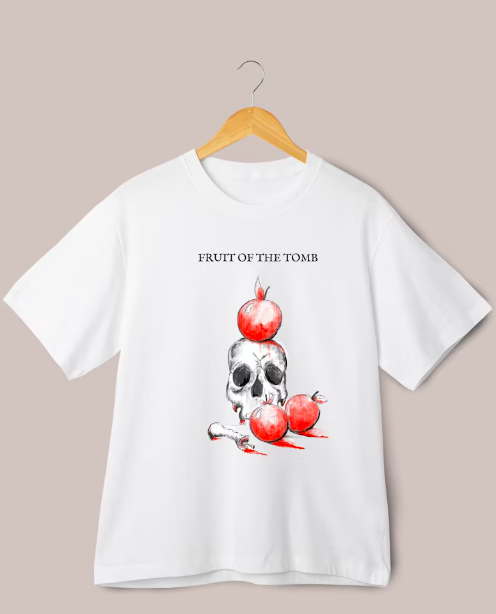
T-shirt with a skull and pomegranate illustration on it that says, “fruit of the tomb.”

I have recently launched a line of Gothic Food-inspired t-shirts available here. As a reader of The Bruja Professor, you can use a special discount code here.

Guest Contributor Bio

Dr. Alessandra Pino holds a PhD in Food, Cultural Memory, and the Gothic from the University of Westminster, following a decade of experience working alongside a Michelin-starred chef. Her research and publications cover topics such as food, cultural memory, the supernatural, and the Gothic. She regularly contributes to Haunted Magazine and Rue Morgue. Alessandra is the co-author of A Gothic Cookbook (2024) and has a forthcoming chapter on Dark Food in The Palgrave Handbook of Literary Memory Studies (2025). She is the writer, producer, and co-host of A is for Apple podcast, which investigates the history of food, and Fear Feasts, a podcast that analyses the horror genre through the lens of food. She is a member of the Guild of Food Writers.

Alessandra's website: www.alessandrapino.com

Map of Italy with a bubbling cauldron and magical sparkles, with the text, “The Bruja Professor: Made in Italy: The Spells and Secrets of Streghe with Alessandra Pino.”

The Bruja Professor, a witchy take on literature, the occult & pop culture, is the scholarly sister to Enchantment Learning & Living, an inspirational blog celebrating life’s simple pleasures, everyday mysticism, and delectable recipes that are guaranteed to stir the kitchen witch in you.

If you enjoyed what you just read and believe that stories are magic & true magic is in the everyday…or your next good read, subscribe to my newsletter below for regular doses of enchantment.

Want even more inspiration? Follow me on Instagram and Facebook. Here’s to a magical life!

Once Upon a Selkie with Kelly Jarvis

Long ago and far away, in the coastal villages of Scandinavia and the Northern British Isles, people told stories about selkies, shapeshifters who shed their seal skins to walk as humans on land. Although traditional selkie tales were used to explore the boundaries between civilization and nature, they also helped communities examine romantic relationships, unions that can be as intoxicating and as turbulent as the ocean itself.

In selkie folklore, the romantic interaction between a selkie and a human rarely results in a happily-ever-after. The Grey Selkie of Sule Skerry, a Scottish folksong, tells of a human woman who gives birth to a selkie child only to learn that her future husband will one day kill both her selkie lover and their son, and Selkie Bride tales usually feature a fisherman who steals a selkie’s pelt to force her into marriage and motherhood. The selkie bride builds a life with her husband and children, but she eventually discovers the location of her hidden seal skin, abandons her family, and returns to her home in the sea. The tragic conclusions of these tales make sense; if a human cannot survive in the water, and a selkie cannot be content on land, any romantic partnership between the two would be doomed. So, why do selkie stories continue to beckon listeners toward their melancholy shores?

While early selkie romances may have highlighted the anxieties of uniting two families in marriage, contemporary novels like Margo Lanagan’s The Brides of Rollrock Island and Rose Sutherland’s A Sweet Sting of Salt use selkie folklore to interrogate issues of romantic agency, casting selkie characters as cultural or sexual “others” to propel poignant messages about human desires, marginalized communities, and queer identities. Although the meaning of selkie folklore shifts over time, the stories often turn on the topic of choice, an idea that is also central to one of the most popularly circulated fairy tales, Beauty and the Beast. We all want the power to choose who and what we love, but the act of choosing can be problematic because it requires us to leave the unchosen behind. In this way, our choices, to love others and to love ourselves, transform the landscapes of our lives as surely as the relentless tides reshape the curves of an island’s coastline. Selkie stories and animal bridegroom tales may be woven from ancient threads, but they remain relevant because their old materials can be unraveled and reworked into innovative designs that speak to the difficult choices modern audiences must make.

As a girl who grew up along New England’s rocky beaches, I have always been drawn to stories of the sea, but my fascination with selkies began when I enrolled in a class called The Wine Dark Sea: Folklore of the Ocean at The Carterhaugh School of Folklore and the Fantastic. The class featured a guest lecture by Terri Windling who brilliantly discussed the somber themes of selkie tales and explained that you “can’t talk about the seal people without also talking about song, or about stories.” She was referring not only to the beautiful selkie songs carried toward land by ocean winds and waves, but to the songs and stories that humans sing about selkies, songs and stories that are often classified under the folkloric category of legend. Like urban legends, fairy legends, and even the legend of La Llorona examined in Weep, Woman, Weep, selkie legends exist somewhere between fact and fiction, inviting their audiences to negotiate their truth status. Some listeners will believe in selkies, and some will doubt the selkies’ existence, but by choosing to embrace or dismiss their beliefs, all listeners will shape the meaning of a selkie tale. In this way, selkie stories are collaboratively created stories about storytelling itself, and stories about storytelling have enchanted me since I first heard the words once upon a time.

Like the selkie folklore from which it is drawn, my novella, Selkie Moon, explores humanity’s connection to nature and the consequences of choosing to love, but at its heart, it is a story about storytelling. The narrator, Isla, is the daughter of storytellers. Her father, an Orkney fisherman, sends her off to sleep with stories spun of words, while her mother crafts tales using stones and shards of sea glass she gathers along the shore. Isla’s mother speaks in a foreign tongue. She spends her days swimming in rough waters. She, alone, knows where to look for groatie buckies, the elusive cowrie shells rumored to bring good fortune to their island community. But, although Isla uses selkie folklore to understand her parents’ troubled marriage, it is the readers of Selkie Moon who must negotiate the truth status of the story Isla is telling. By using the clues Isla scatters throughout her narrative to unlock their own interpretations, readers engage in the collaborative tradition of storytelling, adding their voices to a new selkie legend.

Whenever we are in the grip of a good story, we all become selkies of a sort, shapeshifters who shed our practical skins to swim in the inky oceans of a writer’s imagination. We are swept away by waves of words, captivated by the silver flash of metaphors which dart like minnows through the corners of our minds, and, even when we choose to understand a tale as fiction, we allow ourselves to be transformed by it, returning to the land of everyday life a little bit different from when we left, leaving a faint trace of ourselves upon the sea of story. Our capacity for emotional shapeshifting through storytelling may be yet another explanation for the enduring nature of selkie lore. If we can experience the loss and longing embedded in a selkie story, so too can we experience its peace and its joy. Perhaps when we engage with selkie stories, we are not searching for the happy ending of a fairy tale; our lives, after all, rarely unfold in fairy tale terms. Perhaps when we engage with selkie stories, we are searching for more elusive treasures, the kind that can only be found between the ever and the after, in the liminal space of transformation where the truest magic resides.

Guest Contributor Bio

Kelly Jarvis teaches at Central Connecticut State University and works as the Contributing Writer for The Fairy Tale Magazine. Her poetry and stories have been featured in A Moon of One’s Own, Baseball Bard, Blue Heron Review, Corvid Queen, Eternal Haunted Summer, Forget Me Not Press, Mermaids Monthly, The Chamber Magazine, The Magic of Us, and Mothers of Enchantment: New Tales of Fairy Godmothers. Selkie Moon is her debut novella.

You can connect with her on Facebook (Kelly Jarvis, Author), Instagram (@kellyjarviswriter), Bluesky (@kellyjarviswriter.bsky.social) or visit her at https://kellyjarviswriter.com/

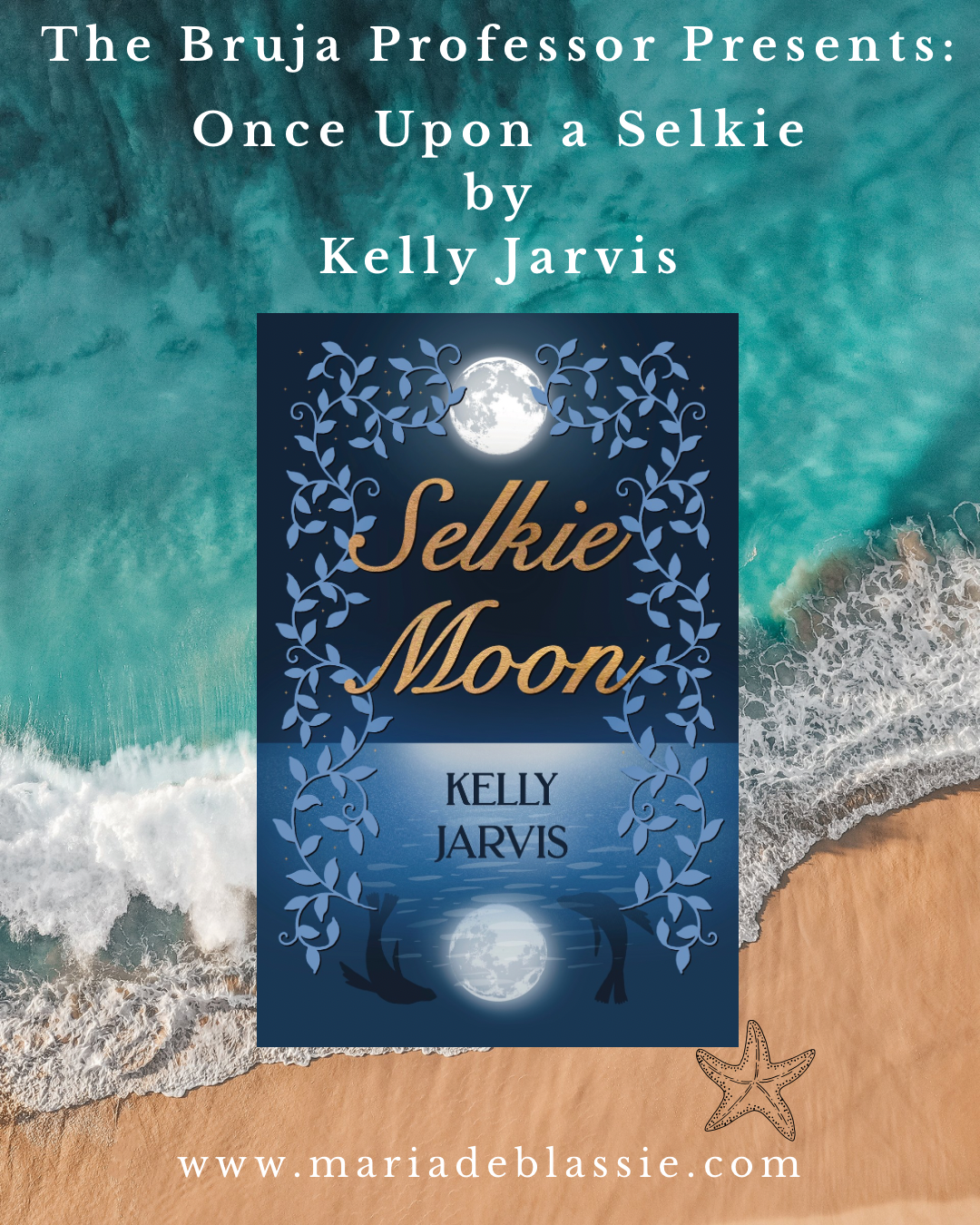
Alt Text: Book cover for "Selkie Moon" by Kelly Jarvis overlaid on an ocean beach background. Transcribed Text: The Bruja Professor Presents: Once Upon a Selkie by Kelly Jarvis

The Bruja Professor, a witchy take on literature, the occult & pop culture, is the scholarly sister to Enchantment Learning & Living, an inspirational blog celebrating life’s simple pleasures, everyday mysticism, and delectable recipes that are guaranteed to stir the kitchen witch in you.

If you enjoyed what you just read and believe that stories are magic & true magic is in the everyday…or your next good read, subscribe to my newsletter below for regular doses of enchantment.

Want even more inspiration? Follow me on Instagram and Facebook. Here’s to a magical life!